Genocide in Gaza and the repression of German democracy
by Dario Morgante
In Germany, organizing a demonstration means submitting to the scrutiny of local security authorities. It is a mandatory step, designed to balance the freedom of protest with public order, but today it is turning into an actual tool of repression.
German authorities can take three different routes: authorize the event, ban it, or grant conditional permission subject to specific requirements. Over the past two years—since October 7, 2023—the “conditional permit” has become the norm for demonstrations held in solidarity with the Palestinian people.
Restrictions are increasingly targeted: banning slogans such as “From the River to the Sea”, limiting the use of certain languages—especially Arabic—or allowing public speeches only in German and English.
“Last year, during one of the pro-Palestine sit-ins in front of the German Parliament, a joint Jewish and Muslim prayer was planned due to a coincidence of holidays, but the authorities banned it, claiming it was necessary to prevent what they considered antisemitism,” says Sophia Hoffinger, Monitor and Research Officer at the European Legal Support Center (ELSC) to Voice Over Foundation. “Across Europe, we observe a systemic pattern of repression against those who support the rights of Palestinians. This is not a series of isolated incidents: it involves public institutions, universities, and governments applying political criteria to limit freedom of expression.”
The ELSC, based in Amsterdam, London, and Berlin, offers free legal assistance to those sanctioned for expressing solidarity with the Palestinian people and conducts advocacy and information activities on the issue since 2019, when the topic was still marginal in European debates. “Even before October 7, 2023, the civic space for pro-Palestine protests in Germany was shrinking, mainly due to immigration and public order laws. In the past two years, these restrictions have intensified and are now being justified through quasi-legal frameworks,” Hoffinger explains.
“One of the most emblematic cases of the German government’s repressive policy concerns a one-year-old child separated from his mother due to her solidarity with the Palestinian cause,”
she continues. In that case, the child was held in Jordan for months after German authorities denied his reentry into the country, labeling him a “security risk.” The measure, formally applied against the child, was in reality aimed at punishing his mother, a Palestinian-Jordanian citizen residing in Germany and a member of several pro-Palestine solidarity groups. On August 5, 2025, the Federal Constitutional Court ordered the family reunification, stating that the separation “exposes the applicant, being under two years old, to irreparable harm” and could constitute a violation of constitutional rights to family protection.
Another element emerging from pro-Palestine protests concerns the geography and dynamics of repression: harsher and more visible during demonstrations organized by the movement itself, more restrained when promoted by major NGOs or institutionally recognized organizations.
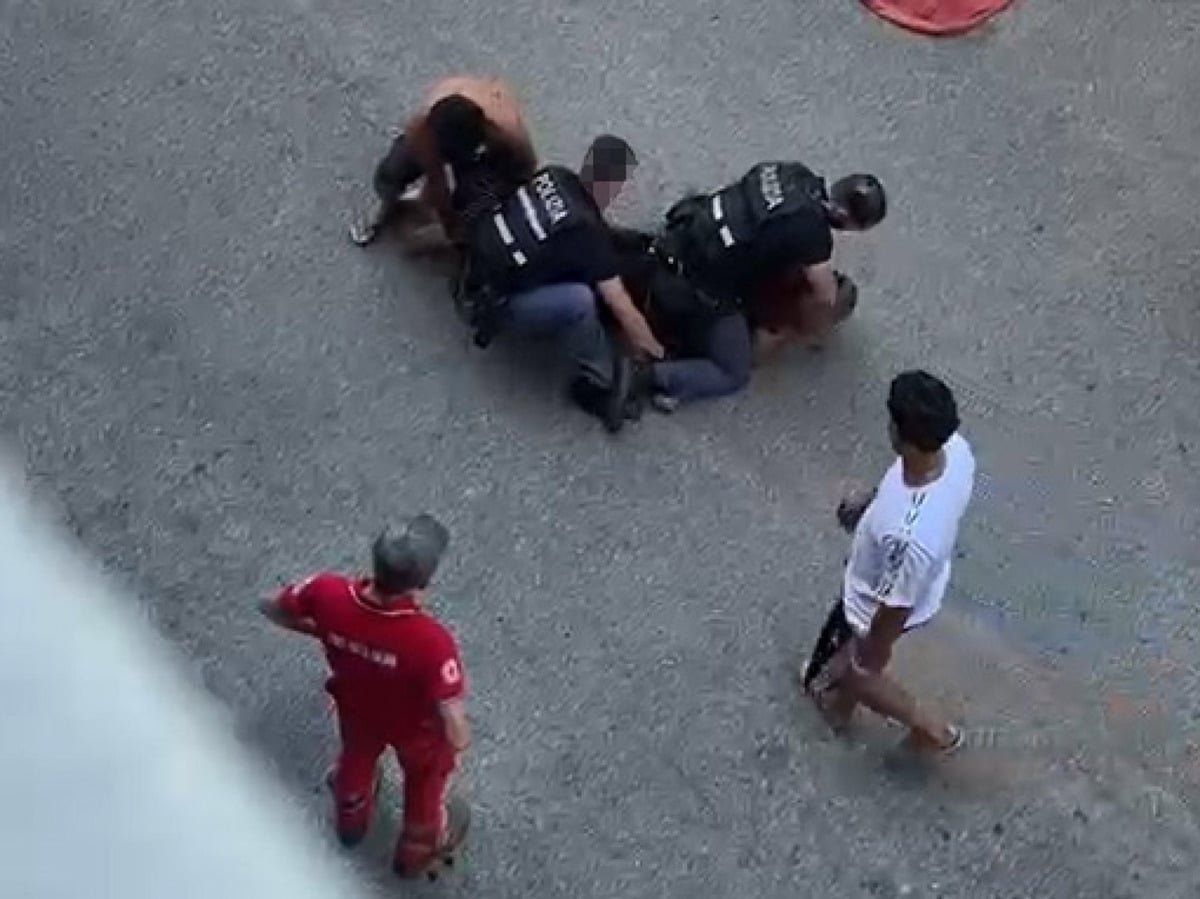
“The brutality of Berlin police is well documented,” Hoffinger continues. “Videos circulating on social media show protesters punched in the face, dragged to the ground, and pinned down with disproportionate force, often without provocation. In several cases, officers also used violence against people who were simply filming or asking for explanations.”
These blatant democratic distortions do not surprise those aware of the economic ties between Israel and Germany. Between 2020 and 2024, the German government accounted for about 33% of Israel’s imports of conventional weapons, suspending deliveries only in August 2025—roughly a year and a half after January 2024, when the International Court of Justice (ICJ) recognized an “ongoing risk of genocide” in Gaza and ordered Israel to adopt measures to prevent it. The Court’s statement did more than acknowledge the gravity of the situation; it reminded third-party states of their obligations under Article I of the 1948 Genocide Convention,
which legally binds signatories to cease any form of material or political support that could contribute to genocide and to take measures to prevent its continuation.
On the contrary, German support for Israel over the past two years has never truly ceased—neither economically, materially, nor politically. In July 2024, Chancellor Olaf Scholz declared: “We have provided weapons to Israel and have not decided to stop doing so.” In May 2025, during the 60th anniversary of diplomatic relations with Israel, President Frank-Walter Steinmeier reaffirmed Israel’s “right to self-defense,” describing German support as “an expression of lasting historical responsibility.” Even when, in August 2025, the suspension of arms exports was announced, Chancellor Friedrich Merz insisted: “Germany defends Israel’s existence and security: it is an expression of our unwavering historical responsibility.”
“The effects of this blind and unconditional support have also resulted in increased domestic repression, affecting cultural and social spaces,”
says Emiko Gejic, a member of one of Berlin’s leading associations for the protection and promotion of club culture and nightlife. In June 2024, the Bundestag passed the resolution “Never Again Is Now: Protect, Preserve, and Strengthen Jewish Life in Germany,” which ties public funding for museums, cultural spaces, and university projects to compliance with the International Holocaust Remembrance Alliance (IHRA) definition of antisemitism—including within it “the denial of Israel’s right to exist or economic boycotts against the state.”
This parliamentary decision was reinforced by the Berlin Senate, which applied even stricter clauses. Starting in January 2024, under the initiative of Federal Culture Minister Joe Chialo, cultural and social venues were required to oppose “all forms of antisemitism according to the IHRA definition.” Seemingly neutral, the rule became a political tool:
“All it takes is one event or statement deemed ‘antisemitic’—often simply because it criticizes Israel or its ongoing policies—to lose all public funding,” says Emiko.
“This approach created both outright censorship of venues stripped of funds—such as the case of the Oyoun cultural center—and widespread self-censorship among cultural organizers, fearful of losing vital financial support.”
The Oyoun case is emblematic. A landmark for independent arts and diasporic communities, located in the heart of Neukölln—one of Berlin’s most multicultural districts, with about 7.9% of residents of Arab origin—Oyoun was accused of antisemitism for hosting events with the collective Jewish Voice for a Just Peace. The Senate immediately cut its funding, condemning the center to slow financial suffocation. The case reached the German Constitutional Court, which in July 2024 ruled in favor of Oyoun, affirming that artistic and expressive freedom cannot be curtailed on political grounds. Yet, the center remains closed.
Protests against the “antisemitism clause” multiplied in the spring of 2024, with banners and red paint filling the streets of Kreuzberg and Neukölln for weeks, reaching even the doorstep of Minister Chialo. A few weeks after its introduction, the Senate withdrew the clause—but the damage was done: funds cut, projects canceled, venues emptied, and a clear repressive message sent. In May 2025, Chialo resigned amid controversy over more than €130 million in municipal cultural funding cuts.
“Many people now avoid taking a stance on the ongoing genocide because they fear censorship, job loss, or withdrawal of funding. Many artists are no longer invited to perform due to their political positions.
Trust in institutions is eroding, and many have already left Berlin,” adds Emiko. Concrete episodes illustrate this trend: on January 12, 2024, artist and DJ Arabian Panther reported that his show at Berghain—the world’s most famous techno club—was canceled due to his pro-Palestine views. The Irish band The Murder Capital also canceled a concert at Gretchen after being told they could not display a Palestinian flag, not even one reading “Free Palestine.”
“Despite this climate of intimidation, positive and resilient initiatives have emerged. Many solidarity networks support marginalized voices and those who have faced state repression. These networks range from cultural activists to human rights groups, academics, lawyers, and journalists,” says Emiko.
“Even in a context of repression and self-censorship, culture can still create spaces of resistance and solidarity.”
Another example is Ravers for Palestine, born out of public dialogue and musician mobilization. The movement promotes the boycott of cultural and social venues that remain silent in the face of genocide while supporting those that keep open spaces of solidarity with Palestine.
Such spaces are increasingly vital for German civil society, as shown by the massive demonstration of September 27, 2025, when over 150,000 people filled the streets of Berlin to demand an end to the genocide in Gaza and denounce internal repression. For a day, the city that most embodies Germany’s contradictions became a stage for collective solidarity, returning to the streets what politics is trying to silence: the voice of dissent.
Leggi anche