
Gentrification in Athens
A political perspective on colonized cities
by Camilla Donzelli
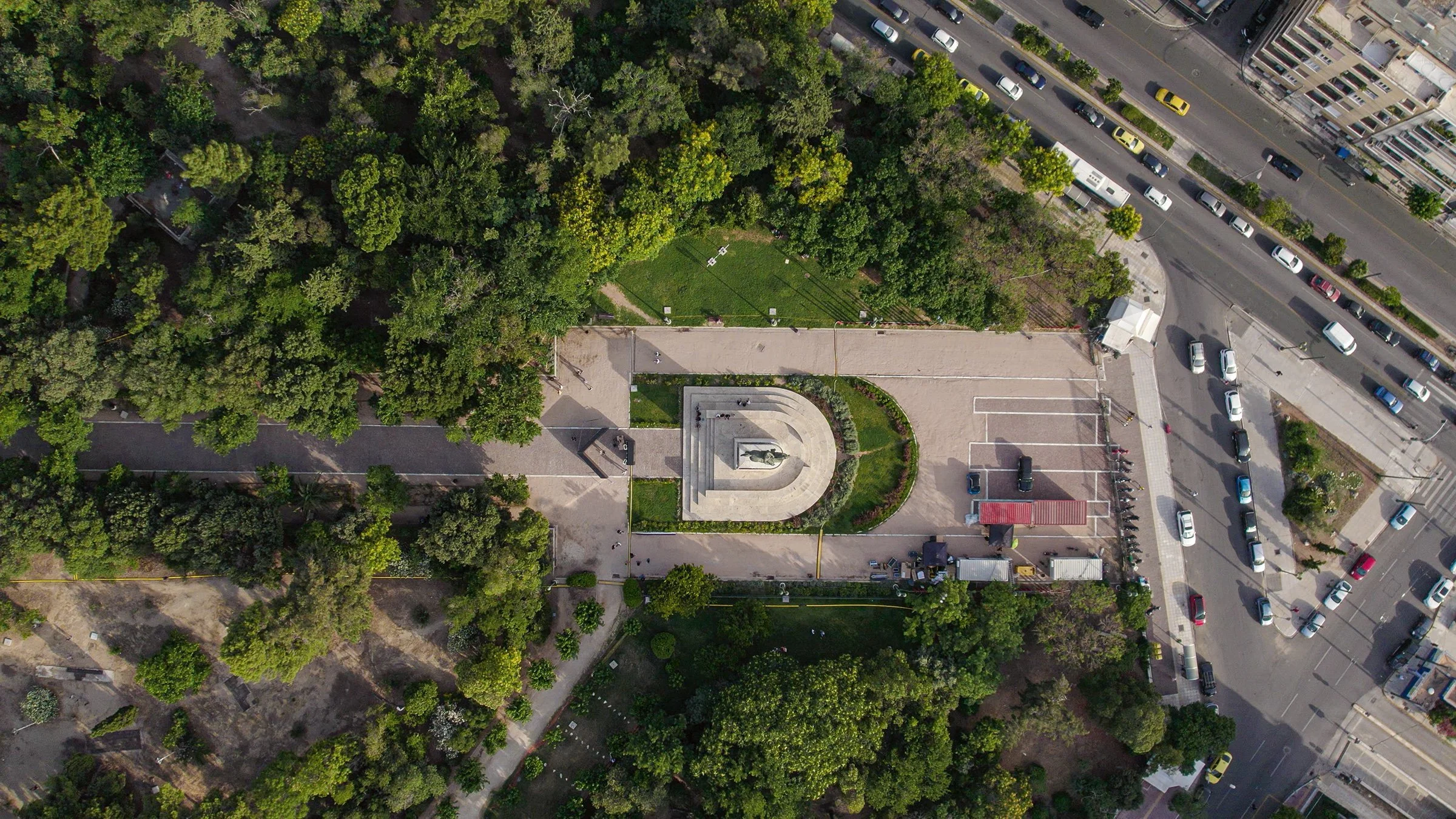
I have lived in Greece for six years, long enough to witness firsthand the effects that gentrification in Athens is producing across many neighborhoods. My small rented apartment is on a street along the northern edge of Exarcheia, in the heart of the city. Every day, I walk a few metres to reach the public park Pedion tou Areos, one of the few green spaces where I can take my dog for a quiet stroll.
During one of my late-November morning walks, as I stepped through the park’s entrance gate, I noticed vans, cables, shipping containers, and small groups of workers scattered across every corner. For the past two years, during the holiday season between December and January, Pedion tou Areos has been transformed into a giant Christmas village. Paths and lawns are overrun with stalls and amusement rides; illuminated installations and selfie spots designed for social media sharing pop up everywhere. Most striking, however, is the pervasive presence of branded elements: wherever your gaze settles, a logo is there to remind you that the entire event has been made possible thanks to the generous support of private corporations.
As I walked among the installations and stalls, I found myself thinking about the concept of colonization.
We often speak of it in different forms, but almost always in relation to liberation struggles unfolding elsewhere—geographically, temporally, and culturally. According to the Treccani dictionary, to colonize means “to reduce a territory to a colony [...] or to establish settlements there for the purpose of economic exploitation and to introduce a different kind of civilization.”
Keeping this definition in mind, I find it difficult to view the transformation of Pedion tou Areos as an innocent festive event.
Rather, I see it as yet another act of appropriation—one in which the features of urban colonization that operate in everyday life become clearly recognizable.
Exarcheia and Pedion tou Areos: the political history of common spaces
To grasp the real meaning of the Christmas installation in Pedion tou Areos, it is necessary to consider Exarcheia’s historical role and the long process of attacks and neutralization that have shaped it over the past several decades.
Since the 1970s, the neighborhood has been the epicenter of political and cultural activity, serving as a point of reference for the city and Greece as a whole.
It was in Exarcheia that the first major uprising against the military junta, which seized power in 1967, unfolded. On November 14, 1973, students at the National Technical University of Athens went on strike and took over the campus, immediately receiving unconditional support from broad segments of Athenian society. The occupation lasted three days and ended in the early hours of November 17, when the army stormed the campus. Though the revolt was crushed with bloodshed, it set off a domino effect that ultimately led to the regime’s fall in July 1974.
The entrance gate, which was crushed by tanks and has become a symbol of the massacre, is preserved and clearly visible inside the university courtyard. Every year on November 17, it is covered with red carnations and handwritten notes. The uprising is commemorated as a symbol of resistance to tyranny, and draws wide participation from the neighborhood and the city at large.
Over time, Exarcheia has remained an open-air political laboratory.
Historically home to anarchist and anti-authoritarian collectives, the neighborhood has defined itself—and has been perceived—as an autonomous zone, marked by unrelenting political and cultural activity shaped by conflict, symbolic production, and radical imagination.
This vitality is vividly captured in the graphic novel Exarcheia Free Zone Calling, by Nikos Koufopoulos and Nikolas Agathos, which portrays the neighborhood as an irreducible, living entity.
It is precisely this continuity between memory, conflict, and practices of solidarity that has made Exarcheia a place under constant observation, surveillance, and attack.
The breaking point came in 2008. On the evening of December 6, in the heart of Exarcheia, fifteen-year-old anarchist Alexandros Grigoropoulos was shot and killed by police officer Epaminondas Korkoneas. The reaction was immediate: the neighborhood became the epicenter of an urban uprising that rapidly spread throughout Greece.
In the years that followed, as the economic crisis deepened, Exarcheia remained one of the main stages of anti-austerity protests, reaffirming itself as a space of convergence for movements, collectives, and subjectivities struck by mass precarization.
It was also in Exarcheia that, in 2015, during the so-called “migratory crisis” affecting Europe’s border countries, a grassroots network quickly emerged to offer a community-based alternative to a profoundly inadequate reception system. Within a few months, twelve squats were opened to host refugees and undocumented migrants.
In the summer of 2015, Pedion tou Areos also became a site of informal shelter: hundreds of families who had just arrived on European shores and were excluded from official reception channels found temporary refuge there.
Although not technically part of Exarcheia, the park has always gravitated around it, both because of physical proximity and historical ties. Pedion tou Areos was established in the 1930s as the first urban park explicitly designed as a space for the Athenian community. Unlike other green areas in the city—originally conceived as private gardens and only later opened to the public—Pedion tou Areos was envisioned from the outset as a place for collective use, encounter, and social life. It is this original vocation that makes it an extension of the adjacent neighborhood.
Because of their political density, Exarcheia and Pedion tou Areos have never been neutral spaces.
They have become strategic terrains on which political and economic power has chosen to intervene in order to redefine who has the right to the city, and under what conditions.
Governing with and for private capital
Over the past decade, the attacks on Exarcheia have intensified. During the 2019 parliamentary election campaign, Kyriakos Mitsotakis, leader of the right-wing New Democracy party, based much of his rhetoric on the notion of “law and order.” In this narrative, Exarcheia was explicitly targeted and depicted as a zone of illegality and disorder to be “cleaned up.” This discourse clearly foreshadowed the policies that would be implemented once Mitsotakis took office.
Now in his second term, the Mitsotakis government has left marks on the neighborhood that are more than visible. The strategy adopted over the past seven years has proven to be particularly effective. Alongside the classic frontal assaults that the community has learned to withstand, such as violent police raids and evictions, a more insidious tool has taken center stage: gentrification.
The first signs of private capital entering Exarcheia had already appeared around 2015, when the economic crisis and the explosion of mass tourism began transforming Athens into a low-cost investment landscape. What initially seemed like a fragmented process consolidated from 2021 onward, accelerating and taking on the contours of a coherent and aggressive strategy.
Under the New Democracy administration, final approval was granted to a controversial project first announced in 2016 by the Tsipras government: the construction of Metro Line 4, which includes a station in Exarcheia’s main square. The objective is clear, and unmistakably political: to force the neighborhood into the orbit of a city center now fully given over to tourism, bringing an end to an autonomous experiment perceived as a dangerous anomaly.
In August 2022, in a city emptied out by the summer holidays, riot police flooded the entire perimeter of Plateia Exarcheion, forming a shield around construction crews tasked with sealing off the square with metal panels. Just over a year later, in November 2023, the destruction of the square was completed with the uprooting of its trees.
Plateia Exarcheion—once the heart of the neighborhood’s collective life, home to assemblies and public debates, solidarity markets, and community kitchens—was thus taken away from the community that had inhabited and shaped it for decades.
Its closure did not merely represent the loss of a physical space, but a symbolic decapitation of the neighborhood: the violent removal of a place where conflict, sociality, and grassroots organizing took shape day after day.
Deprived of its center, Exarcheia’s collective life was pushed to the margins. Some of the neighborhood’s political practices shifted to the nearby Strefi Hill, one of the last remaining public spaces for informal gathering. But here, too, the response was swift: the area was soon absorbed into a “redevelopment” project that translated into a heavy and constant police presence.
What decades of state repression had failed to achieve, gentrification is now accomplishing with relative ease: Exarcheia is undergoing a profound transformation of its social fabric. Using the lexicon of colonialism to describe what is happening is not an exaggeration; on the contrary, it brings its underlying mechanisms into focus.
Private investors are slowly and relentlessly settling into every corner of the neighborhood. Their presence is now unmistakable on every street: entire buildings renovated and converted into co-living spaces for digital nomads, entrance doors fitted with electronic keypads instead of buzzers, anonymous nameplates replacing family surnames.
Finding a studio apartment for less than 500 euros a month has become impossible, against a minimum wage that does not reach 900 euros. And so the original population of Exarcheia is quietly displaced, replaced by that “different kind of civilization” mentioned in the Treccani dictionary definition.
Precarious students and workers, migrants, and “hostile” political subjects are artificially supplanted by wealthier, transient residents aligned with the urban economy of tourism and short-term rentals.
Pedion tou Areos: when public space becomes commercial enclosure
It is within this framework that the Christmas village installed in Pedion tou Areos must be understood. A park is, by definition, an accessible space—a place where leisure is detached from the market, where one can sit on a bench or on the grass, talk, linger without having to purchase anything. The branding of Pedion tou Areos subverts this original function. Public space is reconfigured as a commercial surface, symbolically fenced off before it is physically enclosed, and made accessible only on the condition of participating in consumption.
Alongside the Christmas village is Airbnb’s recent announcement that it will fund improvement projects on Mount Lycabettus, another major green area within walking distance of Exarcheia. This initiative and the festive makeover of Pedion tou Areos are two expressions of the same process: the occupation of public space by private capital under a benevolent guise. In both cases, the intrusion is justified in the name of “progress” and “revitalization.” Yet this rhetoric conceals a familiar dynamic: space is taken away from the community that inhabits it and reshaped to serve the demands of profit, according to extractive and predatory logics similar to those of classical colonial processes.
This is not merely a material transformation, but a far deeper attack. To take away space is to take away the possibility of encounter and organization. It means inhibiting a community’s capacity to imagine collectively, to decide together on the basis of real needs, to produce forms of life not immediately compatible with the profit-based economy.
In other words, it means mutilating the possibility of self-determination. Thus, control over territory becomes control over the political horizon.
What is happening in Athens, however, is neither an exception nor a uniquely Greek phenomenon. It is part of a shared repressive grammar that runs through other European contexts, Italy included. The recent, violent eviction of the Askatasuna social center in Turin is a striking example.
Like Exarcheia, Askatasuna was never merely a physical space, but a political infrastructure rooted in its territory, capable of weaving together practices of concrete solidarity, mobilization, and autonomous cultural production.
Its forced removal responds to the same imperative guiding the “cleanup” operations in Athens: to break the continuity between grassroots organizing and everyday life, neutralizing spaces that make visible the existence of alternatives incompatible with the urban economy of profit.
Cracks in the concrete
Even when space is fenced off, surveilled, stripped of its meaning, something continues to move beneath the surface. Control is never total; colonization is never fully complete. Exarcheia has demonstrated this for decades: every time one place is shut down, another reopens; every time a square is erased, new forms of encounter and organization emerge elsewhere. These are fractures where another idea of the city takes shape—stubborn and fragile, yet far from residual.
In 2009, a group of residents occupied a small plot of land originally slated for the construction of a multi-story parking garage. The space was taken over by an open neighborhood assembly which, through collective contribution and labor, transformed it into a green area designed for social life. Navarinou Park—named after the street along which it runs—has evolved over time, adapting to the needs expressed by those who inhabit it: a community garden, a space equipped for families and children, a site for cultural events, debates, and film screenings.
Navarinou is a political statement about how the city can be inhabited. As explained in its presentation, the park emerged from the need “to reatake control over our daily lives, as well as over our space and time,” counterposing monopolized ownership of urban space with collective, anti-hierarchical, and anti-commercial management. Navarinou asserts the right to the commons and to truly accessible public spaces, removed both from commodification and from managerial delegation to “experts” and “agents” external to the community.
Another example is the Strefi Festival, launched in 2024 by a local collective as a self-organized attempt to reimagine the green spaces of the hill overlooking Exarcheia. In opposition to commercial redevelopment plans and the area’s gradual touristification, the festival proposes art as a practice of reappropriation, promoting the idea that private corporations and large-scale investments are not necessary to create beauty and social life. Through itinerant performances that invite the public into a shared walk from one point of the hill to another, the collective imagination is set back in motion. Space reopens and is called into question; the realm of the possible expands; and the city—even if only for a moment—ceases to be reducible to a commodity.
Experiences of self-organization like these are acts of everyday resistance. To define them as such is not rhetorical exaggeration, but an acknowledgment that cities are not neutral or pacified spaces.
They are battlegrounds where it is decided who has the right to remain, to move, to imagine. Giving these processes a colonial name serves to expose their obscured violence: appropriation disguised as redevelopment, expulsion presented as progress, control legitimized in the name of order. To defend a space, to reopen it, to reinvent it means claiming something more radical than the right to the city. It means asserting the right to existence and self-determination.
