
Demonstrations and La Stampa: why we criminalize anger and ignore repression
by Sara Manisera
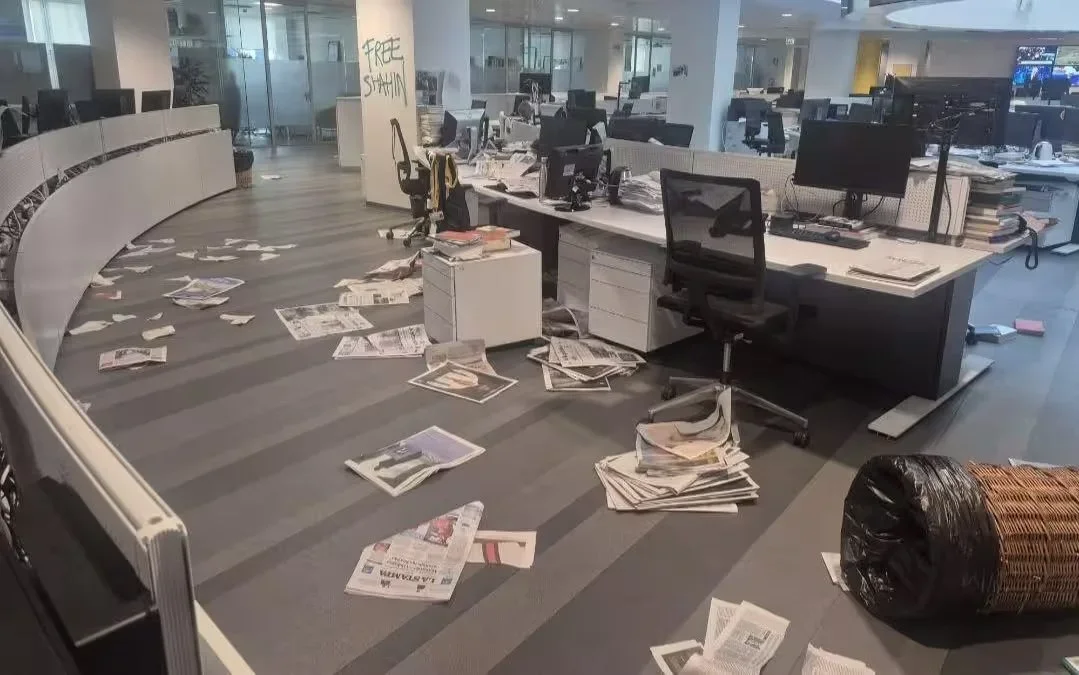
Certainly: the society we imagine should not be marked by violence, nor by attacks on the spaces where ideas circulate and confront one another. It is obvious that we do not like violence — who does, after all? It is not what we aspire to, nor what we wish to cultivate.
Yet, as often happens — think of the broken window at Milan Central Station — a poorly strategized act, which undeniably has a violent component, directed at an empty newsroom — moreover on strike against the precarity that crushes much of the journalistic profession — will end up overshadowing everything else.
And so, for the coming weeks, only this will be discussed: the defaced walls and the disorder, instead of the world that is burning.
But within the various forms of violence, aren’t there enormous asymmetries? Between those who hold power and use violence to govern, repress, exploit — and those who have no power except their own anger and despair?
Between those who can decide what to tell and what to conceal, and those who can only scream into the void?
Wasn’t the silence — and the media shielding — of Italian journalism toward the Palestinian genocide and the killing of more than 250 colleagues itself violent?
Do we really think that not seeing, not naming, not reporting is not a form of violence — perhaps the most refined, the most structural, the most insidious?
And furthermore: isn’t it true that in Italy violence is condemned selectively?
That outrage arises only for the violence that touches our symbols, our buildings, our certainties — and almost never, or only with extreme delay, for the violence that crushes those who are distant, impoverished, racialized, less representable?
Isn’t the proposed “anti-maranza” law itself violent — a racist and classist measure that primarily targets the children of foreigners, poor young people born and raised in Italy?
Where were the intellectuals when something needed to be said about the material conditions, segregation, and systemic exclusion carried out by institutions and the economic system that are generating this anger?
Is it not violent to continue speaking about young people only as a problem to be contained and never as the product of a society that pushes them to the margins?
And then, let us ask ourselves:
How often are young people listened to and given the microphone? How many racialized voices are welcomed by La Stampa and by the press in general?
How many truly diverse, precarious, marginalized voices — not already perfectly integrated into the social and class contexts that count — are actually represented?
Are we really certain that Italian journalism embraces dissent?
Or does it embrace only that dissent which is selected, compatible, docile — expressed by those who already belong to the “acceptable” segments of society?
Before passing judgment on the broken window, the overturned newspapers, the angry chants, the graffiti on the wall, we should have the courage to look at the windows (the doors and the mouths) that many newsrooms keep tightly shut.
If journalism increasingly becomes a sounding board for power, if it stops seeing anger because it continually portrays the same social classes, the same worlds, the same bodies — is it really surprising that many do not feel represented or recognized, but instead labeled as “maranza,” “pro-Pal,” “violent,” “unmanageable”?
I would begin with some self-criticism: who is this journalism speaking to? Who is it addressing? Does it build bridges or reinforce walls? Does it aim to understand, or to flatter itself?
And again, reflecting on violence:
Isn’t it violent for a publisher — a holding company like Exor-Gedi, which also invests in the war industry — to limit, steer, or prevent space for critically writing about companies such as ENI, about its responsibilities, about its violence in the world and beyond?
Who holds more power?
What is the real asymmetry of violence?
At this point another reflection naturally arises: what kind of society do we want? Francesca Mannocchi rightly raises this question, writing that “it is a statement about the kind of society some people desire.”
So I ask in turn: do we really want a society in which deportation for opinion-based offenses becomes normal?
Is a state acceptable that issues expulsion orders, that prosecutes those who protest, that takes a man from his home and repatriates him to Egypt after twenty years of living here? Does freedom of expression apply to everyone, or only to a few?
How much was this state violence amplified? If it had not been for the so-called “Pro-Pal” demonstrators, would anyone have spoken about Mohammed Shahin besides the Bishop of Pinerolo and a handful of others?
And again, how many truly spoke about Ramy’s case — one year after his death — about the grief still being processed by those who loved him, and about the racial profiling experienced by so many people in Italy?
Are we truly certain that journalism gives proper space to these stories?
Who gives them a place to speak without risking being infantilized or criminalized?
Violence today is exercised in many other ways, and although what happened at La Stampa’s newsroom may disturb us — because it is unexpected, because it is frightening, because it exposes deep fractures — the question we should ask is: why? Where does it come from? What material conditions generate it?
And so we must ask: do we really believe that in the face of all this violence — economic, class-based, racial — people, especially young people, will not react?
With what detachment do we expect people to endure in silence while everything around them collapses?
Isn’t it violent to deport a man, a man of peace, who has lived in Italy for twenty years, and see that no one — or almost no intellectual, no “authoritative” voice — speaks up?
Isn’t this the violence we refuse to name because it would force us to confront the complicity of our institutions and the racism we have internalized?
Personally, I believe the action against La Stampa’s newsroom was wrong, short-sighted, senseless, and useless for the Palestinian movement and for all the other struggles that attempted to converge during these days of strike and mobilization.
Knowing our domestic press, it was predictable that the focus would fall entirely on the demonstrators’ violent act, obscuring the other forms of oppression and intimidation — far more violent — that we are experiencing and for which people are mobilizing in the streets.
As a journalist, when I observe young people’s anger toward my profession, I honestly do not feel attacked, because I understand that it stems from their exasperation, their anger, and their fear.
I do feel attacked, however, when the Italian press pays me and my colleagues 15, 20, 35 euros per article, piece-rate, with impossible deadlines and no protections.
I feel attacked when politicians, economic powers, and multinational corporations that pollute and destroy the planet use strategic lawsuits to silence those who ask questions.
I feel attacked when the government and intelligence services infiltrate with surveillance software developed by Israeli companies.
I feel attacked when those who should defend freedom of information remain silent in the face of a genocide and awaken only when a fragment of social unrest reaches their doorstep.
What real power do those young people have compared to a genocidal or repressive state?
What is the real threat: a group of exasperated youths, or an international order that normalizes the annihilation of a people?
To those young people I would like to speak, to ask questions. Why? Where does your anger come from? Who listened to you, who ignored you? What are you asking for? What has been denied to you? What is burning inside you?
Not to justify. But to understand.
Because without understanding, we will continue to produce only punishments, expulsion orders, special laws, repression… and anger. And we will continue to call “violence” everything that does not threaten power relations, while leaving unpunished and unnamed the everyday violence: the violence that exploits, deports, kills, pollutes, censors, surveils, silences.
The violence that simply does not want us to look directly at the violence inherent in those who truly hold power and can easily decide the fate of our society.
