Ecuador: what indigenous strikes against neoliberalism teach us
by Sophia Grew
Night has fallen on the Ecuadorian Amazon. Two sides face each other. On the right, a group of indigenous people and protesters on strike. Some carry spears, their faces painted, necks adorned with feathers and seeds. Others wear sneakers and t-shirts, teenagers with fanny packs slung over their shoulders and their arms crossed over their chests. On the left, facing the group of protesters, are the police. Instead of spears, they hold plastic shields and wear military uniforms. One of them steps forward toward the protesters, looks down at them, and threatens to clear them out. An indigenous person also steps forward. Their eyes seem like flashes of lightning reflecting the burning tires a little further away. “We let your colleagues pass. Motorcycles, cars, trucks. But if you do this, from tomorrow no one we won’t let anybody through.” A few hours later, the police will throw a firebomb, completely dispersing the protest.
We are at Km12, on the road from Nueva Loja (Lago Agrio) to Puerto Francisco de Orellana (El Coca), two of the most important cities in the Ecuadorian Amazon. The paro nacional (national blockade or strike) was announced on September 22, 2025, by CONAIE, the Confederation of Indigenous Nationalities of Ecuador, in collaboration with trade unions and collectives. They are protesting against the government decree that removed the subsidy on diesel, increasing the price of fuel by 55%.
CONAIE: the political force of indigenous movements
Former CONAIE president Leonidas Iza said the measure is the result of the government’s alignment with the requirements of the International Monetary Fund (IMF). For this reason, CONAIE strongly rejected the measure. Since this fuel is used for public transport and goods, the subsidy has a significant impact on people’s quality of life: it keeps the cost of public transport, used by the majority of the population, and the cost of basic necessities under control. “Now you can’t buy what you used to buy with the same money. Sucumbíos is an oil-producing area:
we feed the whole country with what they call black gold, but then we are not taken into consideration and we earn nothing from oil, only environmental contamination.
We don't have a road to Quito, but the government doesn't care: oil, and therefore money, flows through pipes, not roads,” says Melba Chamba, an activist who has been fighting for the rights of the inhabitants of the northern Amazon for decades.
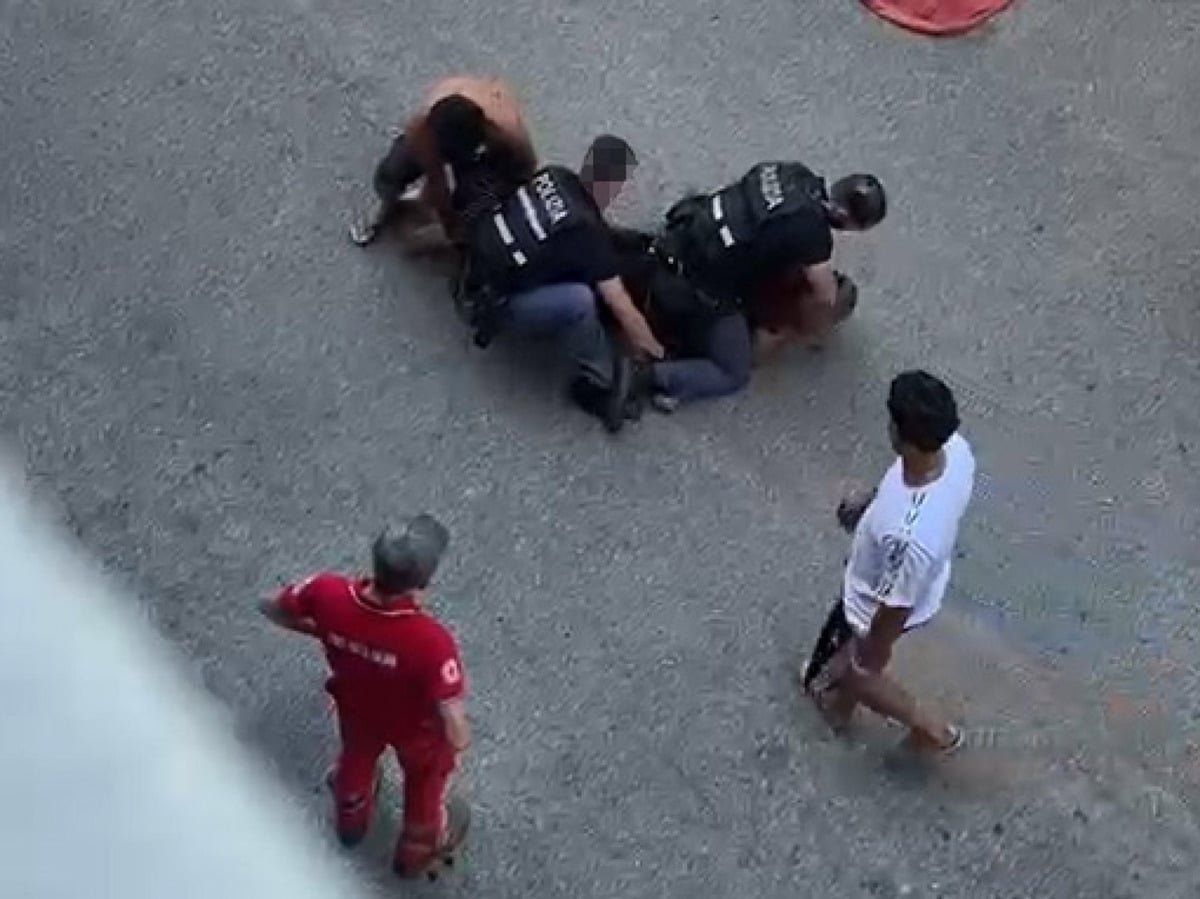
From the outset, the fire of protest has been in the sierra, in the Andes, specifically around the city of Otavalo, a hundred kilometers from the capital Quito. Here, the newly elected president, entrepreneur Daniel Noboa, heir to his father’s business founded on the banana trade, had moved part of the government, probably with the idea of preventing the conflict from centering on Quito. In the province of Imbabura also occurred the first death of this paro nacional: Efraín Furez, a member of a local indigenous community, was killed by state armed forces during a protest. The images were broadcast throughout the country: he was shot but still alive, lying on the ground with a companion trying to help him, when a military truck arrived and began kicking and punching the two men. Fuérez died in hospital the next day, September 28, 2025.
In 2019 and 2022, sudden increases in fuel prices had also sparked protests in the country and then, as in 2025, it was mainly indigenous communities that organized roadblocks and participated in the protests.
From the Sierra to the Amazon: territory, class, and identity
The role of indigenous communities in organizing protests and mobilizations has its roots in the 1990s with the first major uprising, the “Grande Levantamiento Indígena”. The protests began with the symbolic occupation of the Church of Santo Domingo in Quito on May 28, 1990, and ended up involving numerous Andean provinces; roadblocks prevented products from entering the cities. Indigenous communities demanded the legalization of their territories, that is, the right to their ancestral lands, the guarantee of clean water and infrastructure, and the recognition of indigenous cultures. The government was forced to negotiate with CONAIE, and from that moment on, indigenous nationalities began to consolidate themselves as an important political force in the country. In 1992, the indigenous communities of the Amazon marched 500 km from Puyo to Quito to demand, once again, the legalization of their territories and the recognition of Ecuador as a multicultural, multi-ethnic, and multinational state.
Since then, the indigenous peoples have begun to occupy the place left by the labor movements, opposing governments and the neoliberal measures they have undertaken. “The labor movement had lost strength, effectively leaving a void. It was at this point that public sector unions, together with workers in education, oil, health, and social security, allied themselves with the newly formed CONAIE,” Pablo Ospina Peralta, a researcher in Latin American social movements at the Universidad Andina Simón Bolívar in Quito, tells Voice Over Foundation.
“The process of capitalist modernization has torn many indigenous populations from their confinement: with the agrarian reform of the 1970s, many gained access to schools, learned Castilian Spanish, and began to communicate with each other.”
Most of Ecuador’s indigenous populations live in the sierra, or Andean region, and are Kichwa, part of the larger Quechua linguistic group that inhabits the Andes from Colombia to Chile. In the Ecuadorian Amazon, seven indigenous nationalities survive alongside the Kichwa: Achuar, Cofán, Huaorani, Secoya, Shuar, Siona, and Zápara. Today, thanks to the common use of Castilian Spanish, they can communicate with each other and thus organize themselves.
Another important change occurred when indigenous people began to migrate and work in cities: some stopped being farmers or gatherers in the woods and became urban professionals, while remaining tied to their indigenous status and the discrimination that came with it. “They were also influenced by their interaction with some left-wing parties and intellectual catechists,” Peralta adds.
Since the birth of CONAIE, the indigenous peoples of the Amazon have been primarily concerned with environmental issues, first and foremost oil extraction, while in the highlands, movements have focused on the fight against neoliberal economic policies and for land ownership. CONAIE is the result of this plurality of voices; in the early 1980s, leaders from the Amazon, the highlands, and the coast began to come together. Having defined the need to act in a unified manner to make their presence felt, they considered it essential to recognize the duality of the problems, not only as members of different indigenous nationalities, but also as members of a certain social class.
Latin American historian Marc Becker, in his essay Pachakutik, Indigenous Movements and Electoral Politics in Ecuador, observes that CONACNIE (the predecessor of CONAIE) “highlighted the fact that it was a mistake to embrace ethnic identities to the exclusion of a class consciousness.”
Initially, there were tensions due to ideological differences between the Amazonian peoples, who were more oriented towards ethnic issues, and the groups from the highlands, who were rooted in class politics. Over time, CONAIE increasingly aligned itself with anti-capitalist policies. “The struggle acquired a ‘double dimension’ of organizing on a class basis together with other popular movements to transform society in addition to building independent ethnic organizations in defense of Indigenous cultures.,” Becker writes. All this has enabled Ecuador’s indigenous mobilizations to protest forcefully and to ally themselves with numerous non-indigenous organizations equally involved in the struggle against neoliberal and extractivist policies.
Fernando Guarusha, a member of two indigenous nationalities—Kichwa on his mother’s side and Shuar on his father’s—lives near Km12, the site of the protests. “As a child, I lived in a completely wild place. When I was twelve, we left the community because there were no more opportunities, especially economic ones, and because we children were studying at a school located in the suburbs.” Fernando recounts the difficulties he encountered in interacting with the mestizo population, people belonging to different cultures. “There is deep-rooted racism, especially here in Lago Agrio. They see us indigenous people as ignorant people who should only stay in the countryside. They don't realize that we are capable of much more, that we are studying and that, in any case, working in the fields or with animals is also a worthy job.” He adds:
“Here, racism has permeated people since the birth of Lago Agrio. When the Texaco oil company arrived, it did not ask permission from the communities that lived there. The city was built with violence.”
It is therefore not easy to get the mestizos to join the protests. “Here among the communities of the Aguarico River, there is no real dominant identity: it is a place where six indigenous peoples are concentrated, and then people arrived from the coast, from Colombia, from the sierra, Afro-descendants from the province of Esmeraldas. Everyone seems separate. But what I think really unites us is food, because we all work the land. It is important to recognize this common ground.”
Why striking costs more today: militarization and accusations of terrorism
During the national strikes of 2019 and 2022, governments were forced to back down; in the first case, the Moreno government had to waive the decree raising the price of diesel, while three years later, the Lasso government agreed to reduce fuel prices and limit oil exploration. In 2025, however, the Noboa government managed to end the strike without giving in to the protesters’ demands, resorting to authoritarian strategies such as deploying thousands of military personnel. After 30 days of strikes, which resulted in two deaths, 473 injuries, 206 arrests, and 391 human rights violations, CONAIE President Marlon Vargas announced the end of the national strike on October 22, 2025: “Faced with this reality, we have made a difficult but necessary decision: to end the strike, clear the streets, and retreat to our territories.”
If this protest was more limited than previous ones, it is because the costs and risks of repression are high; the increase in diesel prices this year was 55%, hardly comparable to the approximately 120% increase in 2019. “People know they will suffer consequences, but they don't want to risk death or be accused of terrorism. The level of outrage must be much higher for a large number of people to decide to take the risk of taking to the streets to protest,” explains Peralta. However, the indigenous resistance still managed to make its presence felt.
After the strike: the referendum and the defense of the 2008 Constitution
A few weeks after the end of the national strike, on November 16, 2025, support for the government collapsed. The Ecuadorian people were called to the polls for a constitutional referendum: the government proposed to change the Constitution to remove the ban on foreign military bases on Ecuadorian territory, to remove public funding for political parties, and to reduce the number of deputies. Above all, it called for a new Constituent Assembly to be convened to replace the 2008 Constitution. More than 60% of voters said “no” to Noboa.
The opposition campaign was not led by any party, but by social groups that organized themselves from the bottom up. They succeeded in defending the 2008 Constitution, which, among other things, was the first in the world to recognize nature as the beneficiary of legal rights. The opposition campaign led by social movements—including indigenous movements—was successful: the Ecuadorian people decided to put a stop to Noboa’s neoliberal policies and keep the Constitution as it is. They chose to defend peace, parliamentary representation, and environmental protection. It remains to be seen how and if this defeat will impact the government. For now, Ecuadorian movements have proven to be a strong opposition, both in the streets and at the polls.
Leggi anche