The Sea Sacrificed to Capitalism
by Angela Falconieri and Federica Scannavacca
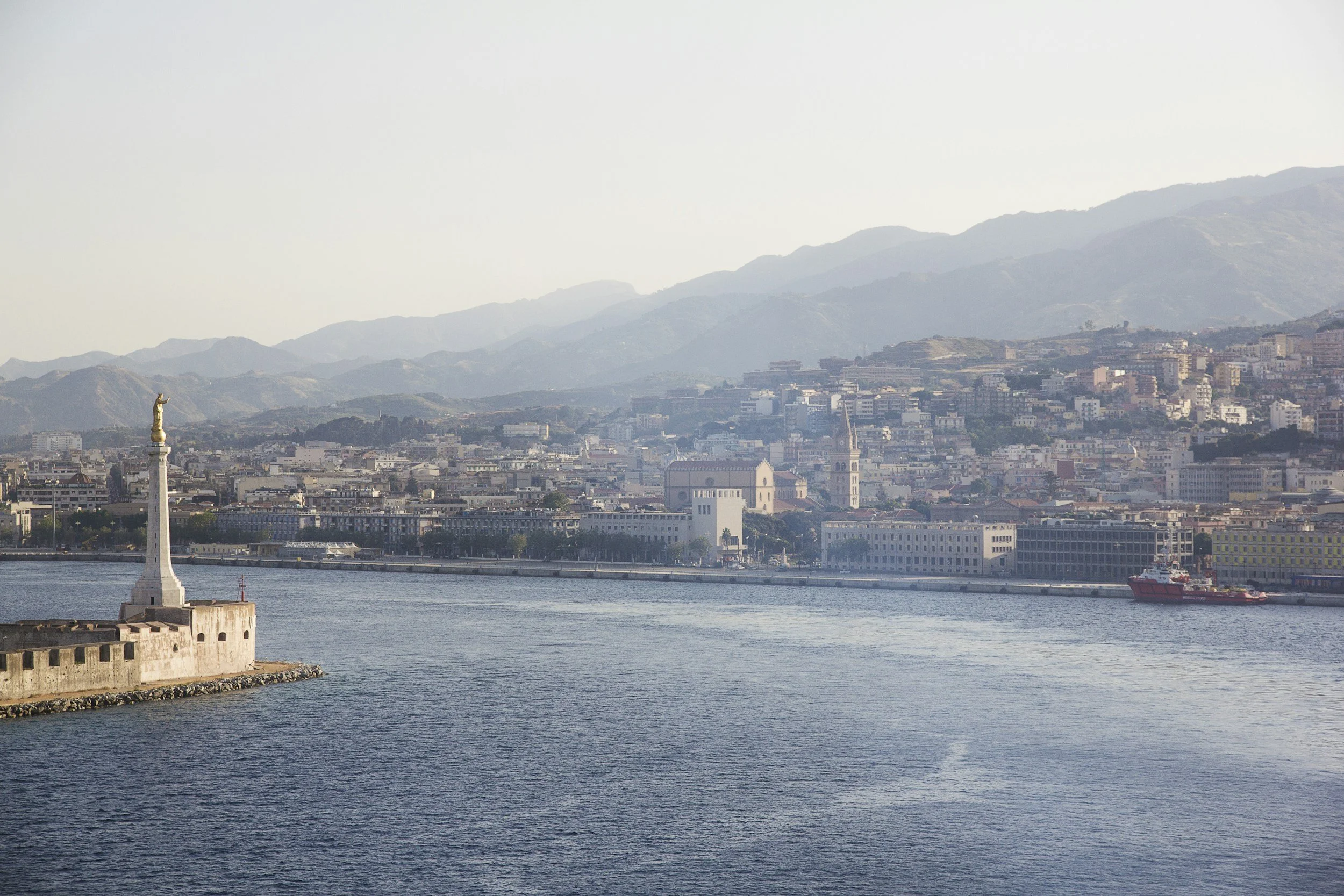
Traveling along the coastal road toward Torre Faro, Messina is a sequence of neighborhoods that narrow toward the sea. After the Paradiso neighborhood, amid 1960s apartment blocks, car washes, and half-closed shops, one passes through Contemplazione, Pace, and Sant’Agata, where the road winds between the coast and low-rise buildings. The Tyrrhenian Sea glistens on the left beyond the guardrail, while to the right, restaurants, kiosks, and beach establishments are stacked. The ‘No Bridge’ flags waving on the rooftops dance in the wind.
«My restaurant has been open for fifty years, and for twenty we have been threatened with closure. Many improvements are needed: worn-out windows, bathrooms to repair. But I don’t feel like investing money in a business that could be wiped out by the bulldozers. And then I have seventeen employees—what should I do?» says Giovanna, owner of the Gitano restaurant.
The Strait of Messina Bridge and the Transformation of the Messina Coastline
Past the last traffic light in Sant’Agata, one reaches the Ganzirri lakes. A strip of land separates the Ionian Sea from the lake, lined with moored boats, birds, and fishing nets drying in the sun. Further along, the road curves between Lake Faro and the open sea. On the horizon stands the red and white pylon, over two hundred meters tall. Between Lake Faro and the Pylon, one of the two massive bridge towers is supposed to rise. The construction sites would occupy this stretch of land, erasing portions of coastline, historical activities, residences, and destroying protected marine habitats.
Among the shadows the Bridge project casts on the Strait’s future, the most significant concerns the seabed—a marine ecosystem of unique value in the Mediterranean.
Here, organisms thrive that are now rare elsewhere, such as the seagrass Posidonia oceanica, crucial for oxygenating the water, stabilizing the seabed, and hosting vast biodiversity; the forests of Laminaria ochroleuca, a large brown algae typical of cold, clear waters found in only a few Mediterranean areas; fossil reefs, the so-called beach-rock formations, ancient rocky slabs formed thousands of years ago and impossible to artificially recreate; and Pinna nobilis, the largest bivalve mollusk in the Mediterranean, currently at high risk of extinction.
Seabeds and Biodiversity at Risk in the Strait of Messina
It is in this context that Professor Salvatore Giacobbe, ecologist at the University of Messina who has studied benthic communities for years, warns of the disastrous impact of the project.
«The existence of vulnerable habitats is acknowledged, but the focus is not on avoiding damage, only on repairing it later, without knowing how. Laminaria forests are naturally regenerating after decades of decline due to the barbaric urbanization of the 1970s; a project of this scale could wipe out this recovery process. In any case, their biology is too poorly understood for artificial interventions. Likewise, Posidonia meadows, already in strong decline across the Mediterranean, could not withstand further pressures.
European restoration laws are being invoked improperly: these laws are meant to restore already degraded habitats, not to justify new destruction with the promise of future recovery», continues Giacobbe.
«In the case of Pinna nobilis, the documents themselves admit that no recovery technique exists. That alone should stop the project». Project hypotheses also include transplants of marine organisms and habitat reconstruction in adjacent areas, solutions researchers deem unfounded because they do not guarantee survival or reconstruction of the original communities.
Construction Sites, Large Projects, and Ecosystem Destruction
On top of this long series of critical issues came the recent rejection of the project by CIPESS (Interministerial Committee for Economic Planning and Sustainable Development), which did not grant final approval. The Committee highlighted serious gaps in environmental assessments, the absence of real guarantees on seismic safety, and the lack of secure financial coverage, judging the compensation measures undemonstrable and unverifiable.
An institutional opinion that confirms what scholars like Giacobbe and local communities have been denouncing for years.
This gap between the project’s actual fragility and the political insistence on repeatedly reviving it raises an inevitable question: who benefits from the Strait of Messina Bridge?
Paola Imperatore, researcher at the Department of Political Science of the University of Pisa on environmental justice issues, told the Voice Over editorial team:
«When we talk about large projects today, we are dealing with a model of territorial governance completely subordinated to capital needs. This is not about side effects or pathological deviations of a healthy system: exploitation, environmental devastation, exceptional territorial governance, and mafia infiltration are not accessory elements, but the very conditions on which large-scale projects today are based».
The refusal of a major project by the local community arises when it becomes a tool for territorial governance serving external interests, increasingly distant from the needs of the communities themselves. In this scenario, socializing costs and privatizing profits is not an anomaly, but a foundational element:
risk is shifted onto the public, while capital can move without real exposure.
Sea Economy Under Pressure: Fishing and Mussel Farming
While the project continues to drain resources, the highest price would not fall solely on the environment, but on the entire marine economy.
«In Lake Faro, the balances are precarious and delicate», explains Giuseppe Donato, mussel farmer. The threat is not only environmental but economic. «Lake Faro is a meromictic lake, permanently stratified: surface layers are oxygenated, while deep layers are anoxic and rich in hydrogen sulfide, a gas toxic to marine life». In these waters, a rare bacterium contributes to the formation of so-called red water, a dense lower layer that, if it rises, can kill entire mussel productions in hours.
«What would happen if the Bridge construction started?» Donato asks. The main concern is the “Pantano” viaduct, planned between the two lakes, which could alter the channel regulating water exchange, salinity, and oxygenation. Changes in water layers could bring the toxic layer upward, contaminating mussel farming areas, while the shallower Lago Grande risks drying out.
«Before threatening a balance that has endured for centuries, they must think carefully and listen to us: if the lake dies, we die too.».
Not only mussels but also swordfish and generations of local fishermen would be affected. Nino Mostaccio, president of the Slow Food Messina Chapter, explains that the massive shadows cast by the bridge towers on the sea would become invisible barriers for sperm whales and dolphins, already disturbed by construction noise. «These animals would avoid the area, disrupting swordfish migration.». With the disappearance of swordfish, one of the oldest local practices—fishing with feluche, long light boats with a high lookout tower and a forward walkway for harpooning—could vanish forever.
The sea, here, is not merely a physical presence: it is a living archive of culture, identity, and biodiversity. And it is precisely this sea that today faces the greatest threat.
Who Benefits from the Strait of Messina Bridge?
Speculative interests orbit the Bridge through a politics of ecosystem destruction disguised as progressive investment, in a territory already heavily marginalized.
The construction of the Strait of Messina Bridge is entrusted to a public concessionaire, Stretto di Messina S.p.A., 55% owned by the Ministry of Economy and Finance and 36.6% by ANAS S.p.A., with minor shares held by the regions of Calabria and Sicily. The company assigned construction of the Bridge and connected works to the Eurolink consortium, led by the multinational Webuild, formerly Salini Impregilo, a publicly listed group indirectly owned by the state via a Cassa Depositi e Prestiti (CDP) fund.
Webuild is today one of the world’s leading builders of large-scale infrastructure, accused by numerous NGOs and international movements of causing serious social and environmental harm in dozens of hydroelectric projects in the Global South. In Italy, its name appears in the first-degree trial on the Third Valico railway, for allegedly opaque public contract management, concluded in 2022 with the acquittal of many defendants, including Pietro Salini, the company’s CEO.
When a flawed project continues to resurface despite failures, rejections, and skyrocketing costs, it means only one thing: the infrastructure itself does not matter, but what revolves around it.
The Strait becomes yet another case where the South is treated as a territory to be exploited, and the Bridge is an eternal promise, continuously evoked while consuming energies and funds, diverting them from real urgencies: failing transport, decrepit schools, inadequate hospitals, and forced migrations that depopulate towns.
According to Federico Alagna, independent researcher and member of the No Bridge Committee, the Strait of Messina Bridge represents an extreme synthesis of these dynamics, and the project’s history demonstrates this.
While earlier versions imagined the Bridge as a public-private partnership, today the investment is entirely public.
«This is one of the points raised by the Court of Auditors," explains Alagna, "because this shift caused costs to explode, exceeding €13 billion.».
The paradox of the project’s scale is that to generate profit, it doesn’t even need to be built.
The Bridge, in this sense, has been ongoing for twenty years, producing hundreds of millions in private profits at public expense, without a single stone laid.
Researcher Imperatore situates this process within a broader geography of devastation and extractivism: «Large projects corrode existing economies and social relations, creating territorial dependence on an often merely promised local economy.». A promise that divides communities, fueling tensions and fractures, especially in historically marginalized areas where dependency on critical infrastructure is easier to create.
Large Projects, Capital, and Democratic Crisis in the South
In Sicily, Alagna observes, Webuild has built a capillary presence in recent years, mainly in railway construction sites.
«This presence is used in the media as a proof of progress.».
The emblematic case is the doubling of the Messina-Catania line, often rhetorically cited in public debate as complementary to the Bridge, despite having a distinct design and financial history.
«Communities want railway investments,» he clarifies, «but it’s one thing to request them, another to have them imposed from above, with routes that devastate involved territories, exclude others, and are built with highly impactful techniques.».
Alagna highlights how this process is functional to a systematic effort to build consensus: «Webuild provides training in regional vocational schools, promoting an idea of development that, if fully followed, makes the Bridge inevitable, if not desirable.». Imperatore links this mechanism to a broader democratic crisis:
«The issue is the right to decide about one’s life and territory.».
The Bridge continues to channel resources, legitimizing construction sites, while the lives of those inhabiting the territory juggle disservices. A fragmented and weakened society is unable to exercise real democratic power, making the role of movements central not only in contesting a project, but in reconstructing a collective capacity to choose which infrastructure, work, and future are truly necessary.
Leggi anche