
The protests in Bologna’s Pilastro district
Eviction, repression and security used to cement dissent.
Dario Morgante
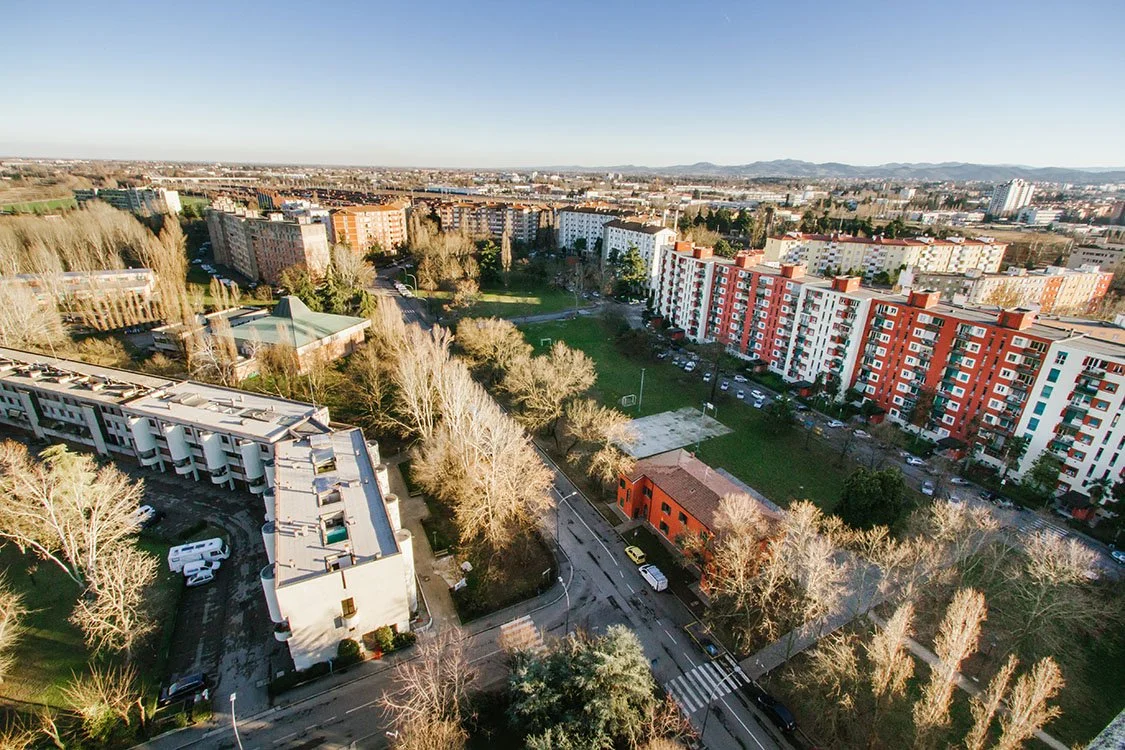
At dawn on March 2, a cluster of brightly colored tents lies still in Mitilini-Moneta-Stefanini Park, in Pilastro, a working-class neighborhood on Bologna’s north-eastern edge. Inside, residents and activists from the MuBasta committee are still asleep. Over the previous week, this patch of green had become the epicenter of a neighborhood protest. The goal: to stop construction of a new Children’s Museum, a six-million-euro project backed by the center-left city administration led by Mayor Matteo Lepore. Assemblies, shared meals of panzerotti, and family activities have filled the park, named after three carabinieri killed in 1991 during a shootout with the Uno Bianca gang.
Laura Pasotti, 53, lives just across the lawn. «This has always been where families meet and kids play,« she says. On the morning of February 23, work crews move in to begin removing trees, as designe by the project. The committee calls an early-morning protest. «A neighbor rang me at six — the trucks were coming, along with the police.» Word spreads quickly through the surrounding apartment blocks. People pour into the street. «For many, it was traumatic to watch the trees in the park under their homes being cut down,» Pasotti says.
That moment sparks a mobilization that, for weeks, reshapes life in Pilastro.
Later that day, an activist from Extinction Rebellion slips into the construction site and climbs one of the trees marked for removal, refusing to come down. By afternoon, firefighters arrive to bring him down. Tensions escalate. Riot police push forward to clear space, while some local youths refuse to move. «They kept saying, «”I’m here — this is my home”» Pasotti recalls. When the activist eventually descends, residents break through the barriers and occupy the park, turning it into a space of collective activity for several days.
Then, at first light on March 2, the eviction. Around 200 officers, 16 police vans and a water cannon surround the encampment. «People were dragged out of their tents while still asleep,» Pasotti says. During the operation, a committee member in his sixties falls and dislocates his shoulder as officers continue to push the crowd back. Within hours, the tents are gone, replaced by increasingly high metal barriers. Bulldozers and chainsaws take over the lawn.
What had briefly become a site of assemblies and shared meals is turned into a fenced-off, heavily policed construction zone.
For Mauro Palma — mathematician, jurist, former national ombudsman for the rights of detainees and founder of the Antigone association — this is part of a broader shift. «There used to be a clearer distinction between different areas of security,» he explains. «Public order at demonstrations, urban safety, stadium policing, prison security.» Today, those boundaries have blurred. «Even before the 2001 G8 in Genoa, the dominant model became one of rigid confrontation, similar to how violent groups are handled in stadiums.» The change also affects police training. «De-escalation is no longer central. Preparation is increasingly geared towards direct confrontation.»
The Pilastro protests offer a concrete example of this shift. The neighborhood is home to around 7,000 residents; one in five is a foreign national, and more than a third live in public housing built in the 1960s during Bologna’s postwar expansion. An expansion that, for the MuBasta committee, has never really stopped.
Each tree cut down in the name of development is seen as a further loss.
«When the councillor presented the museum project in December, we started leafleting to get people to attend and voice opposition,» Pasotti says. «That’s when we set up a group chat — and from there, the committee was born.» At the time, she says, no one imagined that a neighborhood campaign over a local park would trigger such a heavy police response.
By the end of the March 2 operation, six people have been detained. Three — born in 1999, 1997 and 2002 — are arrested and taken to Bologna’s Dozza prison. The main charge is resisting a public official, under Article 337 of the Italian Criminal Code, which in aggravated cases carries a maximum sentence of up to 15 years — more than for some forms of sexual violence or vehicular homicide. The three had been occupying, along with others, the only tree whose removal had been halted in the previous days. After two nights in custody, they are brought before preliminary investigations judge Claudio Paris, who validates the arrests but orders their release, rejecting the prosecutor’s request for precautionary measures. In his ruling, he notes that the defendants are «young, with no prior convictions or pending charges,» and describes MuBasta as «a group of residents and others formed to oppose» the museum project «on what are claimed to be environmental grounds.»
For Palma, one of the most significant changes lies in how dissent is handled within the criminal justice system. «When you ask what ‘security’ means, it depends on who you’re talking about,» he says.
«For a young person, it might mean the possibility of a dignified life, a job, a future. For a Palestinian, it means land and recognition. For me, security is always tied to the right to a future.»
He distinguishes between «security to» and «security from.» «Security to is the security to have rights, to live a dignified life, to move freely as a recognized subject. Security from, instead, is protection from an enemy — from perceived threats, from social groups labelled as dangerous.» In recent decades, the latter has steadily overtaken the former.
In the days after the eviction, the protest does not end. The encampment is rebuilt several times. Assemblies and public initiatives continue, even as the neighborhood remains heavily policed. «There were always police vans outside,» Pasotti says. «Many people wanted to take part, but they were afraid. When you see that level of policing, you start wondering what might happen.» On the evening of March 7, hundreds gather for a march, which is dispersed near the park. «At a certain point, they started firing tear gas at face level. People were running through the streets, under the porticoes, into courtyards.»
Repression, however, does not operate only through arrests or force. It also takes administrative form, as Pasotti herself experienced. «Municipal police fined me €400 for ‘bivouacking’ — because there were tents and camping equipment in the park,» she says. «Then I was also charged, along with two others, for taking part in an unauthorized demonstration.» The charge is based on Article 18 of Italy’s public security law, a framework dating back to the fascist era and still in force, recently amended by a new «security decree» approved by the Meloni government on February 24, 2026. The reform mainly affects penalties: participation in or organization of an unauthorized protest — previously punishable by arrest of up to six months and a fine between €103 and €413 — is now subject to an administrative fine ranging from €1,000 to €10,000. A shift that removes judicial oversight and places enforcement directly in the hands of police authorities, strengthening a model of security that is increasingly administrative and less subject to judicial guarantees.
This measure is part of a broader legislative pattern in which the government has repeatedly invoked emergency decrees to address issues framed as security threats.
From anti-rave laws to the Cutro decree, from measures targeting Caivano to earlier security packages, up to the latest intervention following political controversy over events in Turin on January 31, the trajectory is clear: a steady tightening of the penal tools used to manage social conflict.
In this framework, concepts such as public order and urban decorum have been elevated to core legal goods. «They are highly elastic notions, often difficult to define precisely,» Palma observes. «The risk is that they become catch-all criteria used to limit fundamental rights — freedom of expression, the right to assembly, even the physical integrity of those who protest.» The events in Pilastro illustrate how, in practice, the management of public order can override the claims of residents.
The paradox, Palma concludes, is that this approach may ultimately undermine the very security it claims to ensure. «When security is reduced to protection from an alleged enemy — whether that enemy is migrants, young people, or protesters — society becomes more fearful, not safer.
Increasingly, people feel insecure not because they are under threat, but because they fear the consequences of taking part in public life.»
The protests in Pilastro highlight a further dimension of Italy’s securitarian doctrine, rooted in the largely unpunished state abuses of the 2001 G8 summit in Genoa: repression is not the exclusive domain of post-fascist right-wing forces, but is also widely employed by political actors who define themselves as “progressive.” In this sense, Bologna represents a case study.
The city is governed by Mayor Matteo Lepore (Democratic Party), supported, among others, by Coalizione Civica, a non-party formation that backed his election in 2021 on a platform of environmental, transfeminist and egalitarian policies. On the night of his landslide victory (over 60% in the first round), Lepore described Bologna as “the most progressive city in Italy,” calling on “all progressive mayors to unite.”
Yet throughout his mandate, the mayor has never questioned the use of police forces in managing social conflicts, particularly environmental ones. The events at MUBA follow those of spring 2024 in nearby Parco Don Bosco (San Donato district), where protests emerged against the reconstruction of the “Besta” middle school. The project, funded with over €18 million, partly through EU recovery funds, required the felling of dozens of trees.
The conflict escalated between January and June 2024, with the opening of the construction site, the occupation of trees through wooden structures, and an increasing police presence. In April 2024, a member of the “Don Bosco” committee, then 18 years old, was violently arrested during a nighttime protest using a taser and pepper spray. The young man, a former student of the Besta school and local resident, had entered the construction site at night to take wooden planks, according to the charges later upheld in court. In November 2024, the city administration abandoned the redevelopment plan, compensating the contractor with nearly €1 million. Lepore justified the decision by citing the need to avoid “a G8-style eviction,” explicitly referencing the events of Genoa.
The trajectories of the Don Bosco and Mubasta movements — and the institutional narratives surrounding them — are connected by a common thread. On March 8, referring to Pilastro, the mayor spoke of “political violence” to be isolated, attributing responsibility to “groups external to the neighbourhood” allegedly “instrumentalising” the protests. Days later, during the commemoration of Francesco Lorusso — the university student killed by a carabiniere during the 1977 Bologna protests — Deputy Mayor Emily Clancy, a leading figure in Coalizione Civica, was confronted by protesters in Via Mascarella. “You gassed an entire neighbourhood,” one dissenter shouted. “Your politics is the baton,” another added. Clancy rejected the criticism: “No one can stop me from paying my tribute. I have always done so.”
On Pilastro, she expressed “concern” over tear gas fired at head height and arrests, while at the same time defending the museum project as “a resource for the neighbourhood,” describing the protests as part of an “electoral operation.” The Municipality of Bologna, contacted by Voice Over Foundation regarding the militarisation of Pilastro, did not respond within the requested timeframe.
On March 31, concrete trucks arrived at Mitilini-Moneta-Stefanini, and the grass was covered in asphalt to deliver yet another “urban regeneration” project to the city. As the surface became smooth, orderly and governable, what was buried beneath the new layer of grey was not only the green of the park, but also the assemblies, marches and community dinners organised by Mubasta that had animated the space for days.
It was not only the greenery of Mitilini-Moneta-Stefanini that was cemented. The dissent of an entire neighbourhood was buried with it.
