
Plato in the Belly of the Beast
The Allegory of the Cave and Self-Justifying Imperialism
By Youssef Siher
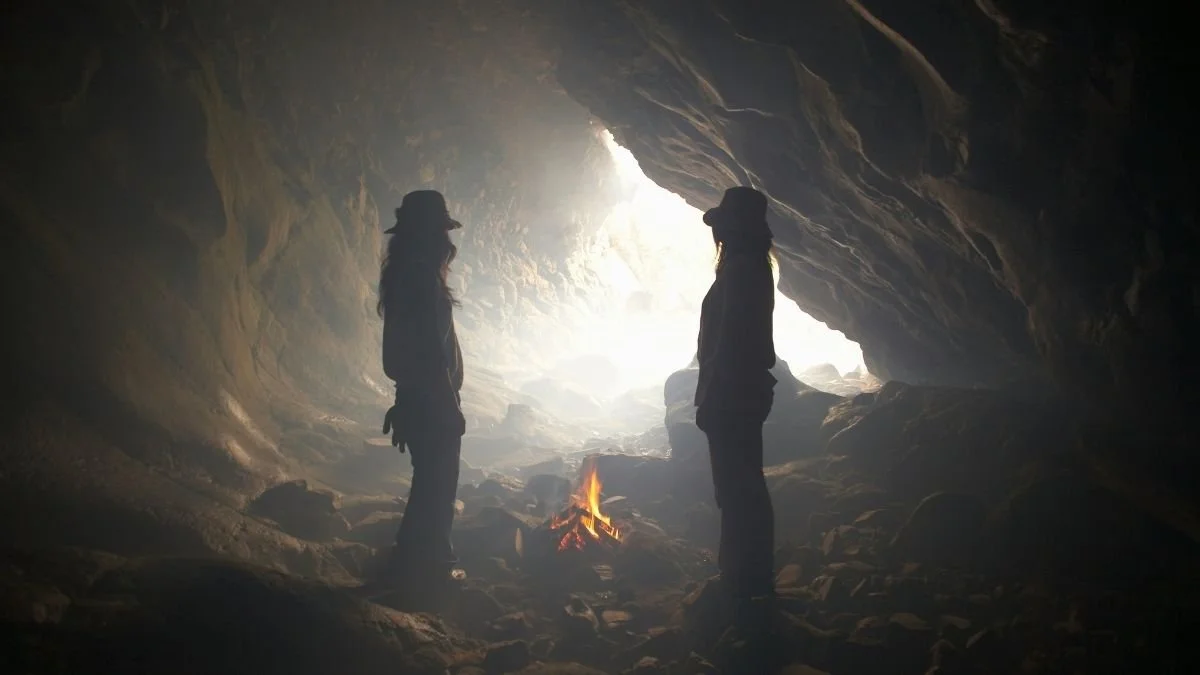
In the Allegory of the Cave, Plato imagines a group of prisoners chained at the back of a cave, condemned to stare at the shadows cast on the wall in front of them. Those shadows are all they know, all they call reality. The fire that casts them is behind them—invisible, never questioned. Whoever manages to free themselves and climb up toward the sunlight realizes that what they called reality was an illusion. But if they return to the others to free them, they are mocked. Or worse.
This is one of the best-known allegories of ancient philosophy, yet it hasn’t aged a day—which, come to think of it, isn’t exactly a compliment to us. Applied to the current world order, dominated by Western imperialism, it ceases to be an abstract exercise and becomes a precise—and, in some ways, unsettling—tool for political analysis. Especially for those who believe they have already emerged from the cave.
The shadows on the wall, or the categories through which the system legitimizes itself
The shadows on the wall correspond to the categories through which imperialism justifies itself: liberal democracy, development, human rights, the free market, and that elegant euphemism known as the “rule-based international order.” None of these concepts is neutral. They are projections of a light source situated in a very specific place—the centers of power in the West—and their primary function is not to describe the world, but to render invisible what that world produces.
The “prisoner” living in Europe or the United States does not see the cobalt mines in the Congo, the proxy wars in the Sahel, the debt mechanism that keeps the Global South nailed to its periphery. They see the shadows:
NGOs, peacekeeping missions, development aid, humanitarian corridors, and that doctrine of truly admirable subtlety known as the responsibility to protect (or the so-called white savior complex)—that sublime doctrine that allows for the bombing of a sovereign state in the name of abstract “universal” values.
Fire, of course, does not govern itself.
Behind it operates a ruling class that has far surpassed the boundaries of the national bourgeoisie in the classical sense: a network of financial capital, multilateral institutions, military-industrial complexes, and elite universities that produce legitimate knowledge
—that is, decide which questions deserve to be asked and which, more quietly, do not. These actors do not necessarily coordinate in a conspiratorial manner—it would almost be more reassuring if they did. They share structural interests in the reproduction of the system, which is far more efficient than any conspiracy: there is no need to order one another to do the same things if everyone is in the same cave.
The Western Left, or those who believe they have emerged from the cave
But the most interesting part of the allegory, applied to the present, concerns neither the unwitting prisoners nor the keepers of the fire. It concerns a third figure, the one Plato leaves implicit and that contemporary politics has made all too visible: those who have turned toward the fire but mistake it for the sun—and in the meantime have also opened an Instagram account to document the journey.
Take the Western parliamentary left. Parties that use the language of social justice, quote Gramsci in the prefaces to their election platforms, express outrage with clockwork precision and the same regularity with which they renew their party membership cards—and then vote for record-breaking military budgets, support armed interventions with just enough formal distinctions to let them sleep at night, and back sanctions that target civilian populations with the same systematic rigor with which they erode the real wages of those they are supposed to represent. Their ultimate horizon is redistribution within the system: a few percentage points of tax on high incomes, a few half-hearted labor protections. The global hierarchy is not mentioned—not out of bad faith, mind you, but because mentioning it would require questioning one’s own position within it, and this is an exercise that no party has yet included in its platform.
Then there is what many of us call the non-profit industrial complex (NPIC)—the large humanitarian organizations that operate in structural symbiosis with Western donor governments, and that perform a specific function: depoliticizing the consequences of the system without ever naming its causes.
This is not an accusation against the people who work there—many of whom are driven by genuine dedication and, in certain contexts, by real courage. It is an observation about the mechanics. The refugee camp is funded by the same state that armed the war that produced the refugees; the mobile clinic operates in the territory that structural adjustment policies have systematically impoverished; the women’s empowerment project is implemented in the country where drones have just completed a bombing campaign. The causal chain is never fully traced—not because anyone explicitly prevents it, but because the system funds what absolves it and leaves unfunded what accuses it. Those who work there are often acting in perfect good faith, and this is precisely the point: good faith serves the system just as effectively as cynicism, with the not insignificant advantage of not weighing on anyone’s conscience.
But the most uncomfortable critique—the one no one wants to hear and almost no one wants to voice—concerns the movements that define themselves as “antagonists” within the imperial centers themselves. A movement that fights for civil rights, recognition of identity, or gender equality at the heart of imperialism may, objectively and regardless of any intentions, serve to perpetuate the system. Not because its demands are false or irrelevant—they are not—but because the decisive question is not what is demanded, but within what horizon it is done. If the horizon is inclusion within the system rather than the transformation of the system, if the struggle is never articulated with that of the peoples from whom that system extracts wealth, if the movement’s budgets, platforms, and visibility depend on foundations funded by capital that profits from the very order it claims to challenge—
then the antagonism has already changed its nature without anyone signing anything. It has become a product.
Packaged, distributed, and consumed by the same supply chain that produces everything else. The market has a truly remarkable capacity to absorb its own criticism: it transforms it into aesthetics, assigns it a color code, puts it up for sale, and organizes a festival with a thirty-euro ticket and a drink included.
Gramsci would say that every system produces its own organic intellectuals, and Western imperialism is no exception—indeed, it produces them in abundance and with excellent salaries. They are academics, journalists, and public voices who are thoroughly familiar with the lexicon of anti-capitalism,

Jorit’s artwork
casually quote Frantz Fanon and Edward Said, sign petitions, and give interviews—and whose careers, visibility, and material sustenance depend entirely on the institutions of the system they analyze. Anglo-American universities, the major progressive media, and cultural circuits funded by private foundations do not censor this critique: they publish it, reward it, and invite it to conferences. They can do so because it is a critique that the system already knows where to place—in cultural supplements, on the shelves of independent bookstores, in moderated panels. A critique that touches nothing structural has the added merit of demonstrating the system’s openness, its capacity to contain dissent without having to repress it. It is the contemporary version of the prisoner who turns toward the fire: he has already taken a step, feels unequivocally enlightened, writes essays on the darkness of the cave—and that sensation of lucidity is exactly what keeps him rooted where he stands.
Those who see beyond the cave: how the system handles radical dissent
Finally, Plato describes the philosopher who returns to the cave and is mocked or killed. It is the part of the allegory that sounds the least metaphorical of all. Those who name the system without mediation—without the appropriate qualifications, without the right tone, without placing the criticism within a framework that the system can recognize as legitimate—receive treatment that varies depending on their distance from the centers of power. National liberation movements are criminalized as terrorist organizations. States that step outside the sphere of Western influence are subjected to sanctions, destabilization, or more creative combinations of the two.
Intellectuals from the Global South who produce uncomfortable analyses remain systematically on the margins of academic and media circuits that nevertheless boast of being pluralistic.
In the imperial centers themselves, physical violence is rarely necessary—it would be counterproductive, as well as aesthetically incompatible with the system’s self-image. Epistemic marginalization suffices: those who see beyond the cave are declared irrelevant, extremist, or pro-authoritarian. This last category is particularly useful, because it allows any criticism of the liberal order to be discredited without having to address its substance—a significant saving of energy, considering the volume of criticism circulating.
What the Platonic allegory ultimately suggests is that the problem of imperialism is not merely economic or military—it is first and foremost epistemological. The system reproduces itself because it controls something deeper than resources and armies: it controls the terms of discourse, the categories through which reality is perceived, the very definition of progress, civilization, and freedom. As long as these categories remain intact, any criticism formulated within them remains a criticism that the system can manage—and usually fund.
Leaving the cave, then, is not primarily a matter of political organization. It is a matter of cognitive rupture: the ability to look at the fire and recognize that it is not the sun, even when that light is the only one one has ever known, even when recognizing it means calling into question years of activism, of identity, of belonging. It means honestly asking oneself in which cave one’s political horizons were formed, who kept the fire burning while one believed oneself to be on the path toward the light, and whether the road one was traveling truly led out or simply circled back to the same point.
It is an exercise no one likes to undertake. It is much simpler to keep discussing shadows—perhaps by organizing a public assembly.
