
Central Mediterranean, where Europe tramples on the rights of those who migrate
by Marco Torri
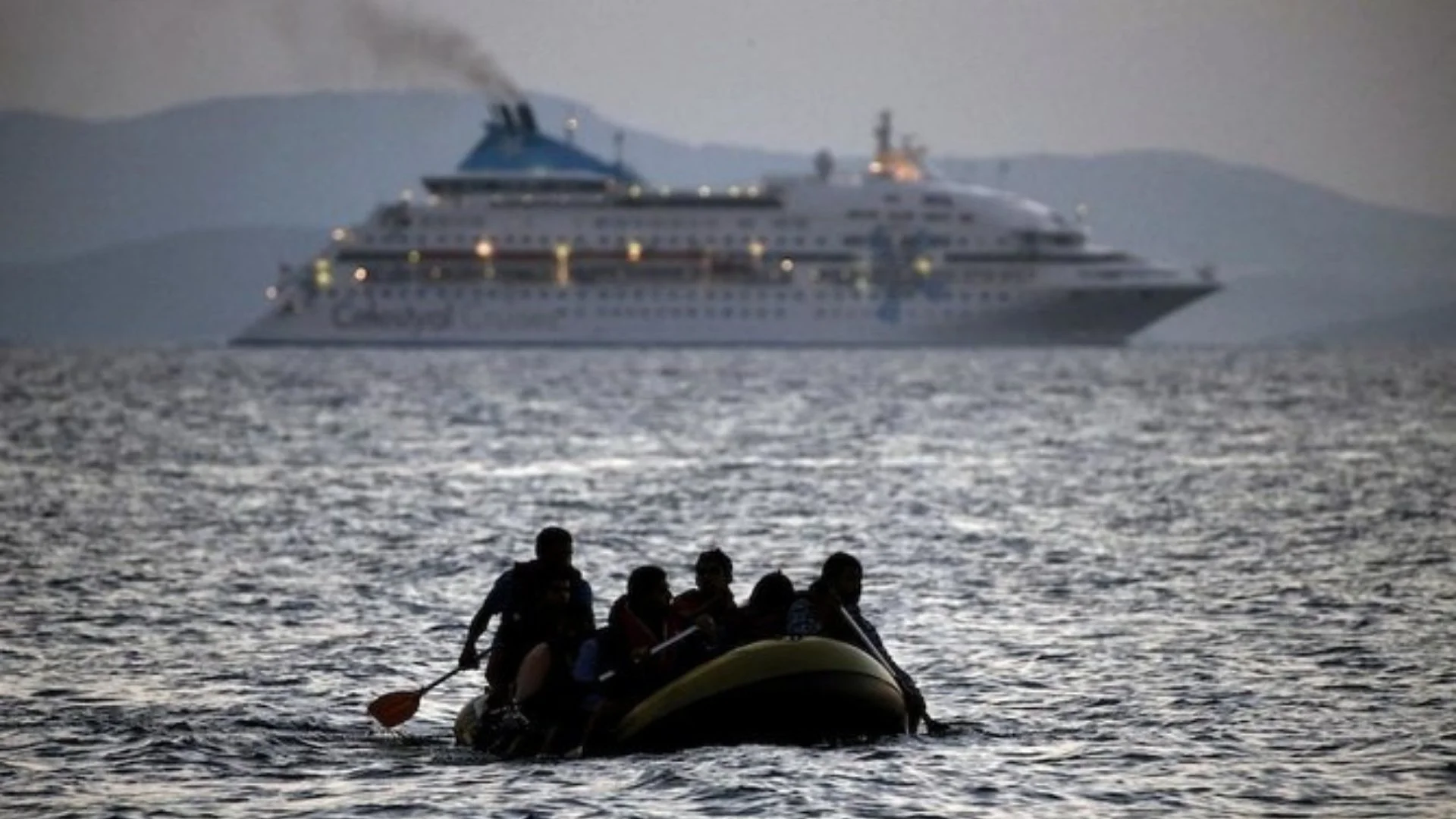
Migrants arrive on the Greek island of Kos (AFP)
Survivors of the sea, with the border stitched into their gaze and at the same time the joy of those who managed to save themselves. This is what can be observed from the deck of the SAR ship Humanity 1, the search and rescue vessel of the German NGO SOS Humanity, which for over nine years has carried out the most human act—and also the one most criminalized by European governments: rescuing people at sea. Perhaps it is from here that we should begin again when speaking about migration.
To understand how the distinction between economic migrants and forced migrants is largely a political and media construction—one that too often fails to recount the complexity of the reasons pushing tens of thousands of people to leave their homeland—it is necessary to remember that every person crossing the Central Mediterranean on vessels unfit for navigation is first and foremost a subject, a person, with a history, relationships, dreams and desires, rights and responsibilities.
Narrative, dehumanization and politics of fear
For this reason, it is necessary to reflect on the uniform and stereotyped narrative of people on the move, often described as individuals who have “chosen” to cross the Mediterranean and who, for this reason, can be left to die at sea. It is an aseptic narrative, devoid of attention to the identity and history of the subjects, which ultimately dehumanizes those who migrate.
A distorted representation of reality, whose main effect is to fuel fear rather than empathy.
Human beings thus become numbers: missing, disembarked, dead. Numbers without context, which contribute to legitimizing policies capable of transforming a structural phenomenon of human history, such as migration, into a crime.
From here arises the “state of emergency,” the rhetoric of invasion, and the consequent deployment of exceptional measures to guarantee the security of European citizens. In the public sphere, extremist movements take shape, such as the “Remigrazione e Riconquista” Committee, which invoke the mass deportation of anyone who is not an Italian citizen. They leverage growing inequalities, the dismantling of welfare systems, and the marginalization of suburbs to fuel anti-immigration sentiments. In contexts marked by high unemployment, fragile services, and urban decay, immigration thus becomes a factor of competition for scarce resources—public housing, assistance, work—and a symbolic cause of insecurity.
Thus, the perception of being “left behind” transforms economic hardship into identity resentment, preparing the ground for narratives that offer simple solutions to complex problems and for policies that construct an enemy to defend against in exchange for consensus.
The Piantedosi decree and the criminalization of NGOs
It is within this context that the Piantedosi decree takes shape, directly targeting the operations of SAR (Search and Rescue) vessels of humanitarian organizations engaged in the Central Mediterranean, long accused of facilitating illegal immigration. The measure establishes, among other things, that ships operating in the Libyan SAR zone without collaborating with the Libyan coast guard or without coordinating with the Libyan Maritime Rescue Coordination Centre (MRCC) violate Italian law and are therefore subject to administrative detention.
In this context, humanitarian actors are effectively forced to interact with an authority they do not consider legitimate, due to its documented involvement in violent pushbacks and armed attacks.
The so-called Libyan coast guard, although officially recognized by the Italian Ministry of Defence, is in reality composed of a plurality of armed groups—including the Nasr Brigade of Zawiya—that operate in coordination with naval officers. In many cases, these are the same groups that control detention centers, where thousands of people are held in inhumane conditions and subjected to violence, torture, and sexual abuse.
At sea, these actors patrol the Libyan SAR zone and carry out forced returns to Libya, often accompanied by physical violence, threats, and degrading treatment. Practices that constitute serious violations of fundamental rights enshrined in international law and European Union law.
Despite this, the European Union continues to provide support through various financial and operational instruments. Among these is the Support to Integrated Border and Migration Management in Libya (SIBMMIL) program, which alone mobilizes hundreds of millions of euros for border and migration control. Additional resources come from the Neighbourhood, Development and International Cooperation Instrument – Global Europe (NDICI), from Operation EUNAVFOR MED Irini (2020–2027), from the EUBAM Libya mission, and from the Internal Security Fund, for a total amount exceeding 130 million euros.
Externalization of European borders
Even the very establishment of the Libyan SAR zone is the result of Italian investments: vessels, equipment, crew training, and the creation of a rescue coordination center have conferred a semblance of legality upon armed militias, enabling them to operate as institutional actors.
But how is it possible that on the northern shores of the Mediterranean the violation of human rights is considered intolerable, while on the southern shores it is tolerated, financed, and delegated? According to what logic are those who save lives criminalized, while those who exercise violence are recognized as legitimate interlocutors?
This is the logic of the externalization of borders: a strategy that criminalizes people on the move, polarizes public opinion, and legitimizes the construction of a Fortress Europe. A logic that transforms border defense into the only possible response to a media-constructed “invasion.”
It is a policy that responds to an unresolved racial question, embedded in the very foundations of the European Union. A policy that draws moral borders even before geographic ones, dividing the world between citizens and foreigners, transforming the latter into illegal subjects simply for arriving from another country and having crossed a border.
Thus public opinion slides into the narrative of the “illegal migrant,” without documents, or “clandestine.” Terms too often used to create an enemy who, upon closer inspection, is merely the victim of a system built to obstruct access to the right to asylum for migrant people.
Civil disobedience and the legal battles of NGOs
In opposition to this logic, some NGOs active in the Mediterranean have chosen the path of civil disobedience, coming together under the name Justice Fleet. This choice involves violating the Piantedosi decree in the name of human dignity, interrupting any form of collaboration with the Libyan coast guard during search and rescue operations.
The objective is to bring this battle into courtrooms, where already in seven cases judges have ruled in favor of the NGOs, not recognizing the Libyan coast guard as a competent authority, in light of the armed aggressions and systematic human rights violations documented.
The historical scope of this stance is evident: it exposes the paradox of a law that obstructs solidarity and legitimizes violence. The price for NGOs is high, considering legal expenses, administrative sanctions, and the detention of ships for weeks, but the cost of obedience would be even higher.
When the law comes into conflict with human dignity
Disobeying the Piantedosi decree is a political and moral response to a system that has normalized violence by rendering it administrative, distant from public view. It is the refusal to accept that the protection of borders justifies the suspension of rights, and that the security of some is guaranteed through the abandonment of others.
In a context where laws are bent to legitimize pushbacks, arbitrary detention, and cooperation with actors responsible for serious violations, choosing not to obey becomes an act of responsibility.
It is an attempt to bring the European Union back to the principles on which it claims to be founded. Perhaps, when legality comes into conflict with human dignity, it is not solidarity that should retreat, but the law that must be called into question.
