The Bridge of Messina and Reggio Calabria
Stories of Expropriation and Resistance from the South
by Dario Morgante
Since early September 2025, the diligent workers of P.I.C.A. srl show up every morning at the construction site on Via Lago Grande, in Ganzirri, a northern district of Messina just steps from the Strait. Famous for mussel farming and its natural beauty, the area lies within the Capo Peloro Nature Reserve. Here, the Municipality of Messina has begun working on a bicycle path meant to connect the lagoon area to Torre Faro, the northernmost tip of the city and the closest point of Sicily to Calabria. But “meant to” is the right expression: the bike path, funded with two million euros from the NRRP,
falls within the perimeter of the future construction site of the Strait Bridge and, if completed, will likely need to be torn up soon after its ribbon-cutting.
Approved on 6 August 2025 by the Interministerial Committee for Economic Planning and Sustainable Development (CIPESS), the bridge’s final design closes a process that has sharply accelerated over the last two years under Giorgia Meloni’s government. Tracing the project’s origins is no simple task: Italy has debated a stable crossing between Sicily and Calabria at least since 1969, when Socialist minister Giacomo Mancini launched an international design competition and introduced, for the first time, the idea of a “single span” bridge—an uninterrupted central arch without supporting piers, intended to overcome the depth of the Strait. The golden era of “bridgism” coincided with the Berlusconi years: the preliminary project went to tender in 2003 and, in 2005, was awarded to the Eurolink consortium. The following year the Prodi government halted everything, denouncing the project as “useless and harmful”, and the 2012 economic crisis under the Monti cabinet buried it altogether.
Today, however, the Strait Bridge is back at the center of national politics, the flagship of Transport Minister Matteo Salvini, its loudest champion. The accelerated timeline was made possible by a sequence of legislative maneuvers, including the so-called “spezzatino decree” (Decree-Law no. 89/2024), designed to divide the project into functional lots and jumpstart construction without a complete executive plan—dodging portions of administrative, environmental, and anti-mafia oversight. Critics argue this approach heightens the risk of infiltration and opaque management while inflating the budget, now estimated at around €13.5 billion, entirely funded through the 2024–2025 budgets and a capital increase for the Stretto di Messina company. The CIPESS green light in early August marked the political go-ahead so definitively that Salvini declared the next day: “Now it’s up to the technicians. My job is done.”
Yet a first—though not binding—stop arrived almost immediately. On 29 October 2025, Italy’s Court of Auditors denied the required legitimacy clearance for the CIPESS resolution, pointing to inconsistencies with EU environmental and procurement law, doubts about actual budget coverage, and the absence of an evaluation of alternative designs. The decision triggered an uproar: Giorgia Meloni called it “yet another judicial intrusion into decisions that belong to the Government and Parliament” and openly attacked the auditors. The Court responded by stressing that its assessment focused solely on legal compliance, not on the project’s merits.
The Bridge: Design, Costs, and Territorial Impact
The bridge—an immense suspension structure with a 3.3-kilometre central span held up by 400-metre pylons, over a hundred metres taller than the Eiffel Tower—is entrusted to the Eurolink consortium led by Webuild (formerly Salini Impregilo), a historic Italian construction giant. Webuild, already involved in environmental controversies, is also among the firms slated to participate in the “reconstruction of Gaza”, part of the land-partition plan pushed by Trump and Western governments.
“A project with billion-euro penalties charged to the State… swallowing vital resources diverted from development and cohesion funds for Southern Italy, and destined to devastate two territories, in Sicily and Calabria.”
This is how the environmental association Italia Nostra denounces the bridge, arguing that it is not an infrastructure serving local communities but a colossal engine of infrastructural extractivism, mobilizing the cement, construction, and land-consumption industries for the benefit of a few major players. “The bridge is harmful not only because it would turn a city of 200,000 people into an enormous construction site, not only for seismic and geological risks, nor solely for the potential mafia infiltrations,” explains Daniele Ialacqua—scholar, former environmental councillor, and co-founder of the No Ponte Capo Peloro committee—in an interview with Voice Over Foundation.
“It would be a disaster for the landscape, a precious and identity-defining asset for the people of Messina.”
Expropriations: Communities in Sicily and Calabria fighting
Ialacqua and his family—teacher and activist Mariella Valbruzzi and their sons Nicola and Giuseppe—live in Torre Faro, and fate dealt them a cruel hand: the wall of their home borders one of the official construction-site perimeters.
“People think the bridge concerns only those who receive an expropriation notice, but nearly every resident will be affected” Ialacqua says. “We launched the slogan ‘We are all being expropriated.’
Not only those whose homes or land will disappear will lose something, but all of us—our health, peace, landscape, and the natural wealth of the Strait will be overwhelmed by the bridge and its works.”
The construction zones will indeed be vast: 43 km² on the Sicilian side and 15 km² on the Calabrian side, effectively turning entire districts into areas subordinated to a single infrastructure.
For Messina, that means one-fifth of the municipality—an area equivalent to 6,000 football fields. The impact is even starker in Calabria: tiny Villa San Giovanni, just 12 km², would be almost entirely engulfed, with neighboring towns implicated as well.
Combined, Sicily and Calabria would host one of the most extensive construction zones ever planned in Italy. To grasp the scale, consider the latest ISPRA land-use report: in 2024, Italy covered nearly 84 km² of natural land with new artificial surfaces—2.7 m² per second—the highest figure in a decade. Construction sites were the primary driver, responsible for about 49 km² of new sealing. By comparison, the area that could be swallowed by the bridge alone—nearly 60 km²—would exceed all new artificial land created in 2024.
“People focus on the feasibility of the central span, but the real impossibility lies in the ancillary works: twenty kilometres of new roads, twenty of railways, docks, logistics areas, tunnels,”
Ialacqua continues. “This will turn the city into a permanent open-air construction pit.” He also warns of subsidence risks: “Deep excavation and the weight of the tunnels could destabilize the hydrogeological balance, causing fractures and ground subsidence, damaging buildings and urban heritage.”
Expropriations are a further point of tension. On the Sicilian side, 448 properties will be affected; around 200 on the Calabrian side—homes (60% primary residences), businesses, agricultural and industrial lots. Granatari is the most impacted area, hosting the bridge’s landing point, but families living far from the project will also be affected. The second-largest construction site in Messina will be in Contesse, 15 km south of Granatari, where 51 homes will be expropriated and multiple buildings demolished—among them the recently built “Residence degli Agrumi” and Palazzo Corallo, erected after the Monti government shelved the bridge and the area was considered safe from future constraints. Today, those buildings stand as symbols of incoherent planning and top-down imposition.
Who Profits, and Who Pays the Price of transformation
“When Monti liquidated the Stretto S.p.A., residents in Granatari became so convinced the bridge was dead that they started renovating their apartments,” recalls Eros Giardina, a retired seafarer whose home now falls within the purple zone—the main construction site.
“Our life has always been lived under the sword of Damocles. The threat of expropriation has marked our existence for decades. Even if the bridge never materializes, our psychological well-being has already been compromised.”
Fiorella Puglisi Allegra, 85, who has lived in Granatari for fifty years, shares a similar sentiment: “Most people facing expropriation are older and have no intention of moving. Living here is a choice, and no compensation can repay that.” Eros adds: “Legally, they should give us the market value plus 15%. But many of us, especially older residents, can’t access mortgages. Compensation doesn’t account for decades of investment, nor for disabled residents whose homes were adapted to their needs. When you seize people’s homes, you seize their intimacy, their story, their life.
“To support each other, Fiorella, Eros, Ialacqua and many others meet at Casa Cariddi, a community space near Padre Pio Square in Torre Faro, steps from the famous Bar Eden, known for its granita and brioche.
Large maps of the project, affected neighborhoods, and properties slated for expropriation cover the central table.
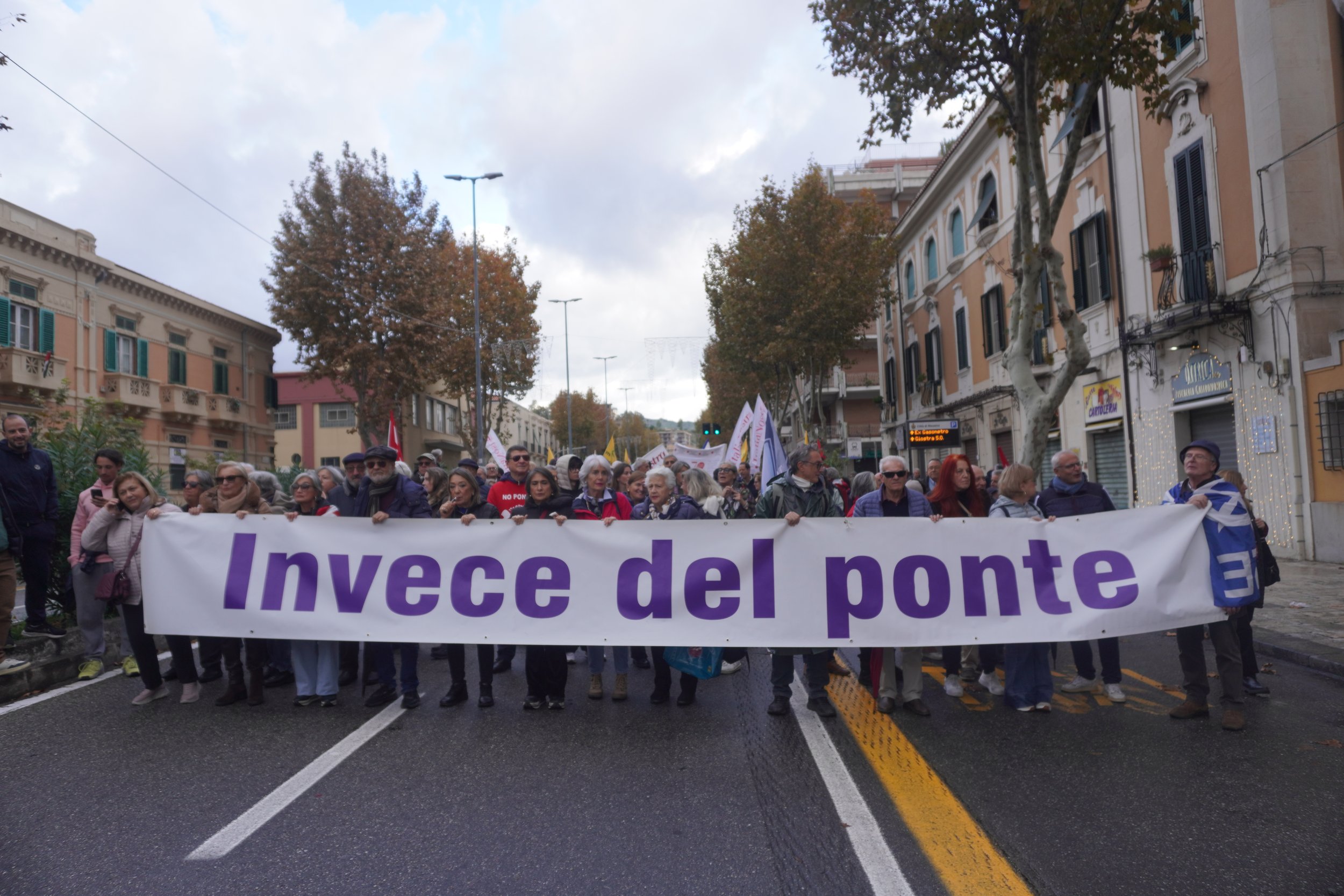
“Many residents learned they were affected only thanks to our outreach or by searching for maps online. No official notice has been issued, even though work was first announced for late 2025 and later for May 2026,” says Ialacqua. Posters of past and future No Ponte mobilizations line the walls. The struggle continues—as shown by the national march on 29 November 2025 in Messina, where about fifteen thousand people braved heavy rain to reject an economic and political model that concentrates wealth and power while imposing social, environmental, and territorial costs on communities.
Alongside local committees—No Ponte Capo Peloro, Invece del Ponte, Assemblea No Ponte—marched groups from across Southern Italy (Italia Nostra, A Sud, No Muos, Libera, Legambiente, and more). For years, they have denounced the South as a hinterland to be drilled, crossed, and sacrificed, forming a broad front demanding that the region no longer serve as a laboratory for top-down mega-projects justified by hollow promises of jobs and progress.
“We witnessed the largest No Ponte march in recent years,” Ialacqua says. “This didn’t happen by chance but is the result of grassroots activism, which has turned the dream of the bridge into its raw reality.”
He concludes: “This project devours the financial resources that the region desperately needs for safety measures, transport infrastructure, water services and social welfare. Just consider that the funds the Sicilian Region diverted to the bridge would have been enough to solve the island’s drought crisis. We don’t need a project that profits a few—we need interventions that benefit everyone. These are two opposing visions of society, two incompatible development models.”
Leggi anche