
How the Fossil Fuel Industry Profits from War
Norway’s Oil Industry: Extractive Imperialism and the Myth of “Green” Oil
by Stella Levantesi
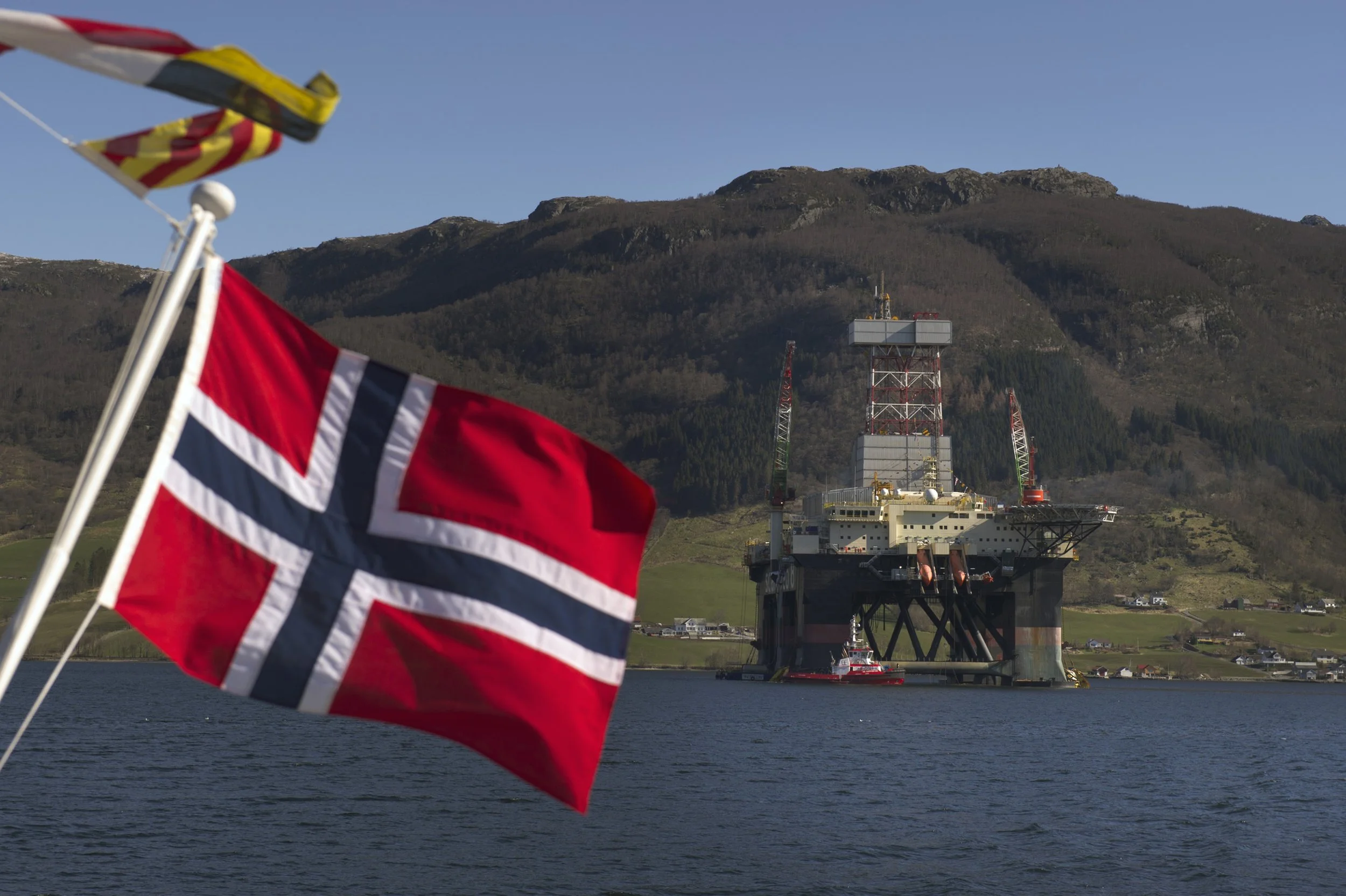
On one side, war; on the other, statements about energy security. Gas and oil supplies are in crisis, and governments are scrambling to secure them. Yet, even when the balance of the supply chain is compromised, the oil industry continues to profit from war.
In March, Norway’s oil exports increased by 67.9% compared to the same month in 2025, amounting to approximately 5.16 billion euros and bringing revenues to their highest levels in recent years, following rising prices and the closure of the Strait of Hormuz.
Norway is thelargest producer of oil and gas in Europe and has now become themain supplier of pipeline gas to Europe, replacing much of the Russian gas.
“[Norway] framed the debate as being the heroic supplier of oil and gas to replace the lost supply from Russia. This new situation [the war against Iran]…will reap massive rewards [to the oil industry] from doing what they’ve always been doing, selling oil and gas,” explained Ketan Joshi, a climate and energy analyst and writer based in Norway, in an interview with Voice Over.
The U.S. and Israel’s war against Iran has made even more evident what was already clear after Putin’s invasion of Ukraine: the world’s dependency on oil and gas is a vicious cycle.
“Norway stepped up the wording on energy security and the ‘Europe needs our gas’ [rhetoric]...‘let us produce the oil and gas the world needs…we have democratic oil,’” said Julie Forchhammer, co-founder ofKlimaKultur, a Norwegian nonprofit organization working to raise awareness and inform the public about the climate crisis, in an interview with Voice Over.
Despite the urgent need to decarbonize and reduce dependence on oil and gas, the CEO of Equinor, Norway’s largest fossil fuel company, with operations in over thirty countries, has stated that the company intends to increase international production by 25% by 2030 and is ready to give the green light to new expansion projects. The company speaks of “reliable” energy supplies. In this scenario, Norway intends to consolidate its role as an “energy lifeline.”
The oil industry’s justifications are, often, always the same, Joshi reiterated. “‘We need to do this to continue to be a reliable provider of fossil fuels to Europe’… It’s just a prediction on my part, but I think they will just be emboldened,” he noted.
The paradox of the “green” and “indispensable” oil
“There’s a lot of people saying that now the world needs Norwegian oil more than ever,” said Forchhammer. “Equinor’s strategy is to be the last oil producing company on earth…It’s like saying Norway should be the last country to give women the right to vote. I like to call Norway the North Korea of fossil fuels because the [internal] debate is so protected.”
One of the fossil fuel industry’s main narratives in Norway, Forchhammer explained, is to keep promoting the idea that oil is necessary and indispensable and that its production can go hand in hand with decarbonization.
Norway is the world’s fifth-largest exporter of oil and the third-largest of natural gas, yet covers 92% of its electricity production with renewable sources, primarily hydropower. Over the years, Norway has presented itself as a leader in the fight against climate change, despite having built its wealth on fossil fuel production. To invest the sector’s profits in the economy, the government created a fund in 1990 with a currentvalue of 1.6 trillion euros and holdings in approximately 8,500 companies across 69 countries, known as the oljefondet (oil fund).
The fund has been criticized for embodying a contradiction. Despite statements about ethical investing, the fundinvests in arms manufacturers, many of which support the genocide in Gaza, and in other companiesinvolved in human rights violations. The paradox is inherent: how can a fund built on oil power be “sustainable”?
Yet, in war and in peace, Norway and the industry claim a commitment to producing the “cleanest” oil in the world.
“The constant here is whether in war or in times of peace, [the industry] will still drill and justify, one way or another,” Juan Pablo Rendon-Betancur, a researcher and professor at the Universidad Católica de Oriente in Rionegro, Colombia, told Voice Over. “In the past, I worked [as an engineer] in the oil industry, and there I understood there’s a common pattern: wherever there’s oil, there are narratives to protect oil interests, and even if the context changes, they always find a way to justify the oil structure.”
Rendon-Betancur, with Cathrine Dyer, a professor of climate change at Victoria University of Wellington, is co-author of a study that investigates whether, despite climate science’s warnings, Norway defends oil extraction, prioritizing economic interests over the climate emergency and social justice. The Norwegian government has managed to construct a narrative in which acknowledging the climate emergency does not imply giving up its oil interests or further oil extraction in the Arctic, the study concludes.
The researchers call it the “green oil” narrative.
“Imagine someone is going to kill a person, and just because the weapon is ‘green,’ you say, ‘Ah, but it’s not that bad’?,” Rendon-Betancur emphasized.
“This is such a recurring theme—saying ‘when we dig up our fossil fuels, we do it in the cleanest way’—which is a misleading way of talking about the impact of fossil fuels,” Joshi reiterated. “The barrels of oil and containers of gas we send overseas produce the same emissions as the ‘dirtiest’ oil you would get elsewhere.”
The narratives of “green” oil and energy security feed off each other.
“They’ll use the issue [of war] with Iran to justify Europe’s energy security. They’ll say: ‘Look, oil from the Persian Gulf is very expensive, so our green oil, our democratic oil, the good oil, will save you. It doesn’t matter if they’re killing people there; we’ll give you security,’” said Rendon-Betancur.
Furthermore, according to the study, the oil narrative presents renewables as an ally of expansion through infrastructure electrification, rather than as a crucial step toward the phasing out of fossil fuels, without ever addressing the issue of oil dependence, and justifying fossil fuel extraction in the Arctic.
Today, it is a common strategy among fossil fuel companies to promote technological applications as solutions to the climate crisis, while in fact continuing to produce oil and gas, and polluting.
Norway, in particular, was also among the first countries to invest in carbon capture and storage (CCS). In the oil sector, the alternative to emitting CO2 into the atmosphere is to inject it underground: for companies producing greenhouse gases, it was also cheaper to store CO2 than to pay the carbon tax introduced by the Norwegian government. In the 1990s, Equinor—then, Statoil—planned to inject CO2 into the North Sea. In 1996, the world’s first commercial-scale storage project, the Sleipner field, was launched.
The Northern Lights project in Norway, managed by Equinor, Total Energies, and Shell, plans to store 1.5 million tons of carbon dioxide emissions within a few years, functioning as a “CO2 storage service” for heavy industry in other European countries. An investigation has shown that the project will face prohibitive costs and transportation capacity issues. Some researchers have pointed out that the fossil fuel industry’s massive promotion of “techno-optimism”—and, in particular, of CCS—aims to delay climate action to continue producing fossil fuels at the same rate: capture, on one hand, to continue emitting, on the other.
As early as 1998, studiesindicated that carbon capture and storage projects like Sleipner could play only a marginal role in reducing carbon emissions, especially if production rates remained unchanged.
Like a drug cartel
Norway, with its wealth, is not among the first to be affected by the impacts of its own fossil fuel extraction and production.
“We, the third world countries, are suffering greatly from racing emissions and temperatures. It doesn’t matter if the ‘quality’ of the oil is green or not. It’s still dangerous; it’s the same oil,” said Rendon-Betancur.
According to Forchhammer of KlimaKultur, the Norwegian oil industry resembles a “heroin cartel.”
“It’s basically like a heroin cartel, exporting heroin and making a lot of money, and we [in Norway] are not seeing the harm our product is causing other places…We are a colonial superpower, with our oil industry, with Equinor operating in the Global South and all over the world, and the oil they’re producing there is definitely not the greenest.
We never see the damage we’re causing [with oil] produced out at sea […] and we’re rich enough to invest all that money in electric cars. “We’re just exporting all the harm and getting all the money,” Forchhammer emphasized.
The Norwegian oil industry is deeply embedded in the school system, investing huge sums of money in promotional activities and sponsoring hundreds of events and educational initiatives. Among the companies, in addition to Equinor, there’s Vår Energi, a subsidiary controlled by the Italian company Eni.
“Especially in Norway, [oil] is so personal, and it starts so early. The way children are exposed to the industry has shocked me, because there’s very little focus on it,” explained Forchhammer.
Last year, Equinorspent more than £200,000 sponsoring science classrooms for children aged ten to fourteen in the Shetland Islands, while seeking approval for development plans for the Rosebank oil field in the North Sea, 80 miles off the coast. In 2024, the Science Museum in Londonended its sponsorship of Equinor due to the company’s failure to reduce carbon emissions and align with the Paris Climate Agreement’s goals of limiting global warming to 1.5°C.
“The biggest difference between Norway and most other countries is how almost every Norwegian speaks what we call ‘Equi-Norwegian’ fluently,” said Forchhammer. “‘Our oil is cleaner. Our oil is more democratic…’ How easy it has been for the oil industry and its enablers to spread that in people’s DNA.”
With a 67% stake, the Norwegian government is Equinor’s largest shareholder, and, as with other countries where the largest oil company is government-owned, the state’s political line largely overlaps with the company’s.
“I think they [the government] are indistinguishable [from the industry].
The court cases that have been brought against the Norwegian government really just force them [the government] to think about how the state and the fossil fuel industry are actually separate,” Joshi said.
New Oil Imperialism
For the Norwegian oil industry, new concerns about energy supply—exacerbated by the war—represent yet another economic opportunity.
The country hopes to exploit the war to secure the European Union’s green light for drilling in the Arctic. Current EU policy commits the bloc to pursuing an international moratorium on oil and gas extraction in the Arctic, but political officials and industry groups arelobbying in Brussels to weaken the ban.
“They are taking advantage of the situation to exert pressure,” said Anne Karin Saether, project manager at the Norwegian Climate Foundation, an independent organization that promotes science-based climate policies, in an interview with The Japan Times.
The Norwegian consulting firm Rystad Energy proposed excluding the Barents Sea, part of the Arctic Ocean north of Norway and Russia, from the EU’s definition of the Arctic in order to “boost production.” Today, the Barents Sea is considered one of the most “promising” oil and gas frontiers on the Norwegian continental shelf.
Arctic exploitation not only accelerates climate change and the destruction of ecosystems, increasing emissions and threatening marine biodiversity, but it is the latest frontier of fossil fuel system abuse. From its very origins, oil colonialism has followed ancient dynamics: profit and power are used to generate new profit and maintain power.
Shell, for example, was founded in 1897 in what is now Kalimantan, Indonesian Borneo, a former Dutch colony, and used its colonial profits to launch extraction projects in new territories. After Indonesia nationalized parts of the oil industry, the Dutch discovered a gas field in the province of Groningen. The field, one of the largest in Europe, sparked oil and gas exploration in the North Sea, continuing to this day.
“Europe is desperate for Energy, and yet the United Kingdom refuses to open North Sea Oil, one of the greatest fields in the World. Tragic!!!”, U.S. President Donald Trumpwrote on Truth Social. “Aberdeen should be booming. Norway sells its North Sea oil to the UK at double the price. They’re making a fortune,” he added.
In addition to environmental and climate impacts, a report by the Norwegian Climate Foundation, titled “The Barents Sea at Stake,” highlighted security concerns. Due to its proximity to Russia, the area would be an easy target for Putin.
The fossil fuel system represents a vulnerability for energy security. Yet, once again, industry and some politicians are ready to justify fossil fuel extraction and expansion in the name of the greater good.
“These people [industry leaders and politicians] are very careful to explain their actions. They need to convince you,” concluded Rendon-Betancur. “But you only need to convince someone if that someone has power.”
