
Weapons to Israel: is Leonardo S.p.A. guilty of Genocide?
The Civil Lawsuit Against Leonardo S.p.A. and the Story of Hala Abulebdeh
by Dario Morgante
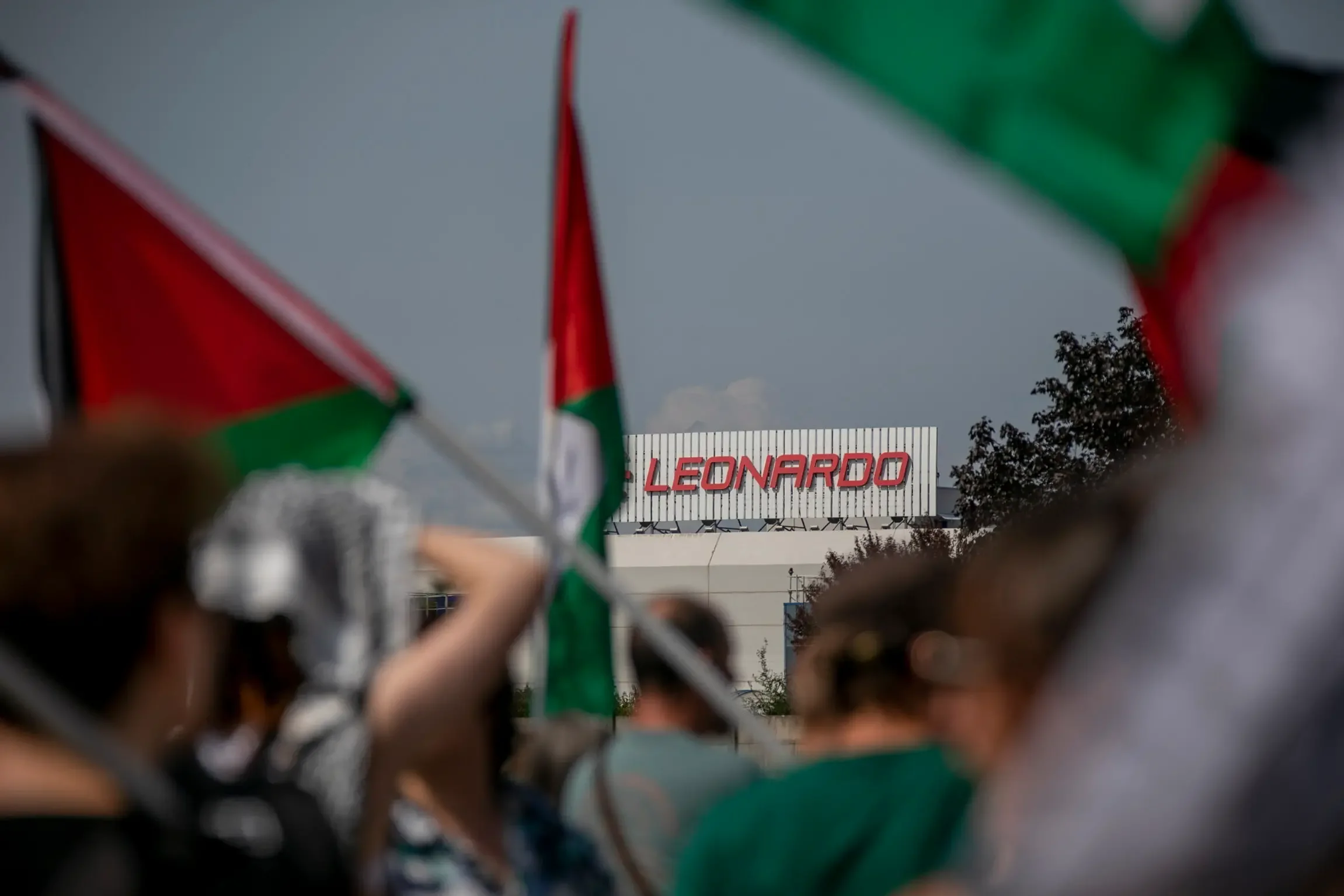
The headquarters of the Basso Foundation is located on via della Dogana Vecchia in Rome, just a few meters from the rear entrance of the Italian Senate. The building once belonged to Lelio Basso, a lawyer, journalist, anti-fascist, member of the Constituent Assembly, and among the architects of the second paragraph of Article 3 of the Constitution: «It is the duty of the Republic to remove economic and social obstacles which, by effectively limiting the freedom and equality of citizens, prevent the full development of the human person». Today, the building houses a library, a journalism school, associations, and international organizations. On the ground floor, beyond a corridor of gray stone, periodically lined with panels on Gramsci or the Cuban resistance, there is a conference room. Here, on November 19, a cluster of civil society organizations — AssoPace Palestina, Pax Christi, Attac, A Buon Diritto, Un Ponte Per, Arci, and Acli — convened a press conference to launch a legal initiative as ambitious as it is unprecedented: a civil lawsuit against Leonardo S.p.A., Italy’s main defense multinational, and the State, seeking the nullification of military supply contracts with Israel.
A series of cold-toned neon lights illuminates orderly rows of red chairs, with black armrests equipped with a small surface for placing laptops and notebooks. The room is small but full, and some people remain standing, pressed against the walls. “Libertad para los presos y deparecidos politicos” reads a 1980 poster hanging on the wall. One after another, the organizations present take the floor, retracing the genocide in Gaza and examining the role of the Italian government and Leonardo S.p.A., an Italian defense giant, 30% owned by the Ministry of Economy and Finance and, among other things, a key component in the global F-35 supply chain which, since October 8, 2023, has enabled the dropping of 85,000 tons of bombs on Gaza.
The words follow one another without mediation: colonialism, apartheid, complicity. In this sequence, one name emerges repeatedly, spoken almost in a whisper.
Hala Abulebdeh is not present in the room, yet she represents the human and legal core of the civil lawsuit against Leonardo S.p.A.
A pharmacist, born in Saudi Arabia and raised in Gaza and now living in Scotland for years, she is the only individual plaintiff in the legal action. Under Italian law, there must be a «concrete, personal and current interest»: someone who directly embodies the harm.
In her case, that interest takes unmistakable shape on December 12, 2023, when, while she is in Europe, an Israeli military attack destroys her family home, where her parents, four sisters, and one brother. All of them are brutally killed.
«My first memories of the occupation of Gaza go back to when I was very young», she tells Voice Over Foundation from her home in Glasgow, where she now lives and works. «I was five or six when I started hearing about people being killed by Israeli soldiers. The light from the Israeli watchtower behind my grandparents’ house in Rafah scared me, and as a child it felt like a nightmare». Then the jeeps, which at night «entered neighborhoods to frighten people, to search for Palestinians and make their presence felt». During the Second Intifada, in 2000, her mother was hospitalized at Nasser Hospital in Khan Younis when «Israelian soldiars stormed in, shooting everywhere». Then, she recalls, «the neighbor’s son, killed and loaded onto a bulldozer» and the «throwing of bombs and tear gas into my grandparents’ house».
At the time she was eleven years old. Gaza was still occupied by IDF soldiers, and internal checkpoints represented the most insidious face of the occupation. «The checks followed a very detailed, obsessive procedure. They checked clothes, objects, bags, everything». Once, Abulebdeh, still a child, was taken alone into a room and searched: a metal detector had picked up a dangerous bracelet in the back pocket of her pants. «One made with soda can tabs», she specifies. «They searched me alone, as if I were a suspect. Even as a child it all felt strange, too meticulous, too invasive». The same pattern repeated during her university years: «Going to university was exhausting. Sometimes I would wait all day at the checkpoint, and if they opened it at the end of the day, it no longer made sense to go to class and I would go back home. I even missed exams».
Zionist checkpoints in the Palestinian territories are not merely security posts, but function as an assembly line of humiliation and dehumanization of Palestinians.
The pharmacist recalls: «One day, a classmate of mine was crying and we didn’t understand why. Then we realized she needed to go to the bathroom but there was nowhere to do it. We had to look for houses along the road and knock to ask to use theirs. Another time they told us cars couldn’t pass and we had to walk. People got out of their cars and started walking. Then the soldiers started shooting everywhere. We ran, not knowing where to go. People fell to the ground out of fear».
Violence also repeated itself in the most ordinary moments of the day, when lines became endless, turning a simple car ride into a survival test: «People got out of taxis and cars and walked forward, then crammed back into vehicles to try to pass. A four-seat car would end up carrying six or seven people». During Ramadan, «we had no food. We tried to find anything to break the fast. I remember an orange shared among ten people. Some fainted or got sick». In summer, conditions worsened: «sometimes they turned off the car engine while we were stuck at the checkpoint and we stayed there suffocating inside. It was like being trapped in a cruel role-playing game. But it was our daily life». One day, a friend told her that a soldier had opened fire on a university colleague she was sharing a taxi with. «They killed him and my her bag was soaked in his blood».
Until the age of sixteen — and as long as Israel allowed it — Hala alternated periods in Gaza with others in Saudi Arabia: «Life there seemed stable, more normal. At first I didn’t understand why Gaza was so different, why there was occupation, why they were there. It has always been difficult to accept that our lives could be broken like that, that freedom of movement was never really normal».
From 1967 Israel maintained a direct presence in Gaza, changing its strategy of ethnic cleansing only in 2005 with the withdrawal of troops and settlements.
Since then, the occupation has not ended but changed form, strengthened through new surveillance technologies and military apparatuses, continuing to exert total control over access, essential goods, international organizations, and journalists — by air, land, and sea.
Nearly two million people confined in what is defined as the “largest open-air prison in the world”.
«After the Israelis left Gaza, life became even harder because they controlled everything from the outside», she says. «Even the most basic things were limited. Food was reduced to a minimum. Sometimes you couldn’t even find chocolate, or makeup for a girl who had just gotten engaged».
Even after leaving Gaza and moving to Europe to complete her studies and work in the pharmaceutical sector, the Zionist occupation continues to shape her life:
«When someone leaves Gaza, they cannot easily return; and if they return, they might not be able to leave again».
Once the lottery of passports and visas is overcome, being Palestinian or from Gaza takes on a different meaning: family ties are broken along irreversible trajectories, and those who leave do so knowing they may never see their loved ones again. «It feels like everything is designed to destroy families», she says. «I felt guilty for leaving. I kept asking myself why I had left my family. Maybe if I had been there, I could have helped them, reassured them, done something».
Then October 8, 2023 arrives, the ground invasion of Gaza and the beginning of Israel’s final operation. «In those months I felt guilty even for eating, when other people were starving. I felt guilty for sleeping, for drinking water, for charging my phone». Nights shrink into fragments, the phone always on vibrate, news flowing without interruption. «If I fell asleep, it was for thirty or forty-five minutes at most. I was afraid there would be an attack and my family wouldn’t know what to do».
On December 12, 2023, Hala Abulebdeh’s entire family was exterminated by Israel. She learns about it only days later, when a message of condolence from a neighbor in Gaza breaks the sudden and inexplicable silence of her relatives. Until today, just three of the seven bodies have been found. It is this event that grounds the legal action promoted by Italian civil society. «Contracts between Leonardo and Israel violate fundamental norms», explains lawyer Luca Saltalamacchia to Voice Over Foundation. «The civil lawsuit against Leonardo S.p.A. is based on Article 11 of the Constitution and Law 185 of 1990, as well as international obligations that require states not to contribute to illegal situations. The point», he continues, «is that these norms bind not only the State, but also private actors. There is no neutral zone where the market can operate independently of the law». Hence the reference to Articles 1418 and 1344 of the Civil Code: a contract is null when it conflicts with mandatory norms or serves to circumvent them. «This is decisive», he concludes, «because it shifts the focus: not only the political responsibility of states, but also the economic and contractual responsibility of those who participate in the supply chain».
The request is clear: terminate all existing relations and prohibit new ones, including “dual-use” goods and services, formally civilian but usable for military purposes. The lawsuit operates outside traditional administrative channels, where export control is entrusted to government licenses, and directly calls upon the ordinary judge, reconstructing in detail the connection between the production of military goods and genocide. F-35 components, M-346 aircraft, AW119Kx helicopters, radar systems, tank technologies, and remotely guided bombs: not a single supply, but a widespread industrial network across plants, subsidiaries, and international partnerships attributable to Leonardo S.p.A.
The first hearing took place on March 27, 2026, before the Rome Tribunal in written proceedings, without oral discussion. The judge has not yet issued a decision, having up to thirty days to rule on preliminary issues, including jurisdiction, standing, and possible disclosure of contracts.
A similar trajectory is outlined in the dossier produced by the collective Giovani Palestinesi in Italia (GPI), together with various international solidarity groups — People for Embargo on Palestine, Palestinian Youth Movement, The Weapon Watch (TheWW), European Legal Support Center, and the BDS Movement (Boycott, Divestment, Sanctions). The document, Made in Italy for the industry of genocide, analyzes shipping records, bills of lading, and cross-referenced industrial and logistical chains, reconstructing in detail Italian military supplies to Israel.
«What mainly emerges», says a GPI representative, «is that these data contradict government statements». Despite official claims of suspension or restriction of exports, the dossier identifies at least 416 military shipments from Italy to Israel after October 2023, as well as more than 224 kilotons of fuel.
Behind these figures lies a billion-euro supply chain involving companies, infrastructures, and institutions, including airports like Fiumicino and Malpensa, and ports such as Genoa, Ravenna, and Taranto.
«For us it was important to show that behind the diplomatic and geopolitical complicity of the Italian government with Israel there are also materials, goods, and above all a working class involved»,
she continues. «Precisely they, by opposing it, can make a difference, as happened in autumn 2025 with the general strikes launched with the Unione Sindacale di Base». The point, she insists, is to make visible a structural contradiction: while public discourse claims limits and controls, «the numbers of shipments that continue make this position not credible».
Hala Abulebdeh also shares the need for boycott as the only concrete tool available to Western solidarity with Palestine and opposition to an imperialist and neo-colonial system aimed at ethnic cleansing.
«I appreciate empathy, but I appreciate action more», she says, explaining why she chose to place herself at the center of such an ambitious legal initiative:
«For us Palestinians it is not really an option to remain silent. No one can enter Gaza, so if we don’t speak, who will tell what is happening? There are thousands of people living the same experience, but they don’t speak English or are not ready to tell it. I feel I must do it, because I can».
On life in Scotland, she adds: «Even after leaving Gaza, the war doesn’t leave you», describing a discomfort that persists far from the Strip: «I can’t stand the sound of ambulances, fireworks, helicopters. Everything takes me back to the war. Even car noises remind me of F-16s. My body reacts immediately».
Finally, she distances herself from the categories often used to frame her experience: «Sometimes I avoid people because I don’t want to be treated as a victim. But I also don’t want to be treated as a hero. I am just a person. Some see you as a victim, others romanticize your story. I don’t like either. Telling my experience is difficult, because then questions come, and those questions can be very painful».
She then recounts an episode. She is in Glasgow, at an art exhibition dedicated to the genocide, in the first weeks after deciding to go out from her place, following months of physical and mental suffering. On the walls, glossy cards with photographs taken in Gaza show devastation: rubble, faces, destroyed cities, accompanied by numbers of tens of thousands of deaths and hundreds of thousands of injuries that condense the violence inflicted on her people and her family since October 8, 2023.
An elderly Scottish woman with white hair is drawn to her presence, approaches her and asks: «Where are you from?».
«Gaza», Hala replies, watching the woman’s face darken.
«Then she asked me about my family and I told her what had happened. At that point she started crying. Uncontrollably. I wasn’t prepared for that reaction and I felt sorry. Then I thought: I shouldn’t be the one consoling her. I can’t be the one».
