
Made in Italy for the Genocide Industry
Italy’s complicity with Zionism and the work of Palestinian Youth to expose It
by Youssef Siher
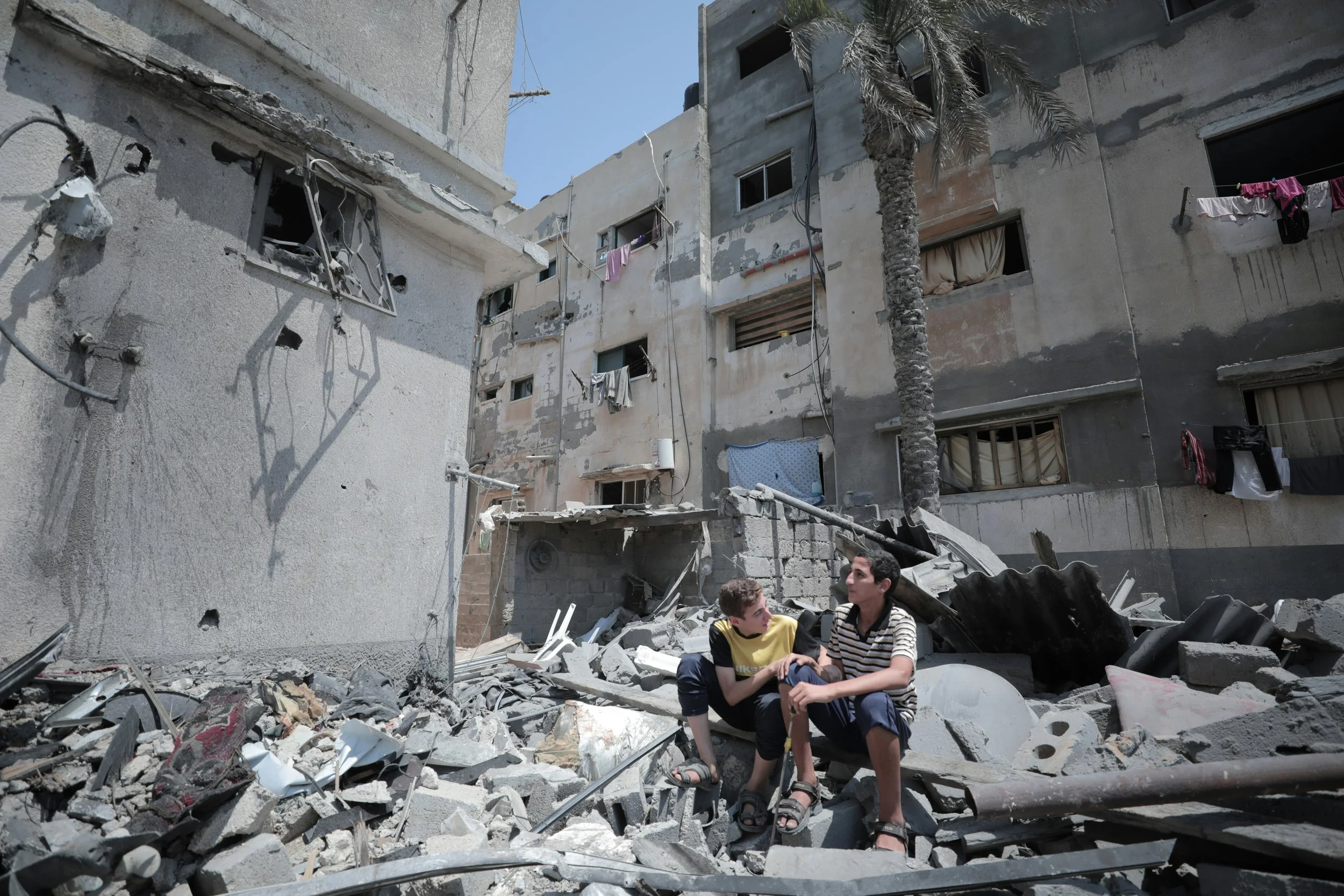
Fotografia di Mohammed Ibrahim
Since October 2023, as images of the genocide in Gaza circulated on the phones of millions of people around the world, the Italian government has adopted a clear stance: that of concrete and material support for Zionism, hidden behind a facade of rhetoric. On the one hand, there are the public statements by Antonio Tajani and Giorgia Meloni: “We have limited arms exports to Israel,” repeated like a mantra at every press conference. On the other hand, there is a documented reality—comprising shipments, shipping routes, and cargo flights—that dismantles that narrative piece by piece.
What has unfolded over the past three years is not merely a contradiction between rhetoric and government practice. It is something more precise and more serious: it is complicity. An active, material complicity, measurable in metric tons of fuel and components for fighter jets.
A complicity that has a name—genocide—recognized as a “plausible risk” by the International Court of Justice itself as early as January 2024, and which has led to arrest warrants issued by the International Criminal Court. This picture is further confirmed by the United Nations Special Rapporteur on the Occupied Palestinian Territories, Francesca Albanese, who, in presenting her report to the Chamber of Deputies, denounced the fact that between 2020 and 2024, Italy was the world’s third-largest supplier of arms to Israel, after Germany and the United States.
Yet the Italian media and political establishment has treated this complicity as a technical matter, to be left to parliamentary committees, export regulations, and the bureaucracy of authorizations. The work of the Palestinian Youth of Italy (Giovani Palestinesi d’Italia, or GPI)—a Palestinian- and Arab-led diaspora organization in Italy that has been organizing active solidarity efforts on the ground for years—has broken through this veil of normalization, bringing into the public eye what the establishment had every interest in keeping in the shadows.
What the report revealed
The report “Made in Italy, Delivered to Israel”, produced by GPI as part of the international People’s Embargo for Palestine campaign in collaboration with the Palestinian Youth Movement (PYM), Weapon Watch, and the European Legal Support Center (ELSC), is a research document that cross-referenced shipping records, customs data, flight manifests, and public information to trace the supply chains linking Italian industry to the Zionist war machine. “The methodology is the result of a coordinated international effort, developed over the course of years,” explains Samed Ismail of the GPI’s National Executive Committee. “On the one hand, researchers within the movement have developed tools to access data that companies have every interest in keeping hidden. On the other hand, the campaign relies on the direct involvement of workers in the sectors we are investigating: they are the primary source, the point of contact with the concrete reality.”
The numbers speak for themselves: at least 416 shipments of military equipment and over 224 kilotons of fuel have left Italian territory bound for the Zionist entity since October 2023. These are therefore not supplies dating back to before the genocide, but rather a continuous flow—despite official statements claiming a suspension—as confirmed by Altreconomia’s investigations into the case of fuse assemblies exported from the province of Viterbo in June 2024, materials that can be used to detonate bombs and projectiles.
The investigation identified private Italian companies, state-linked entities, and logistical infrastructure—ports, airports, and fuel terminals—as key nodes in this network. Airports such as Rome Fiumicino and Milan Malpensa, ports such as Genoa and Ravenna, and energy terminals in Taranto and in the Bay of Santa Panagia in Syracuse are involved. Fuel shipments, in particular, were carried out using actively evasive methods: ships turning off their AIS transponders to hide their route, last-minute changes in destination, and logistical maneuvers designed to evade public oversight. “Rather than a surprise, I’d call it confirmation,” explains Ismail. “The investigative work has confirmed something we already knew:
companies systematically manage to circumvent the law with virtually no consequences.
The case of Ravenna is emblematic: there are bodies responsible for oversight, but in practice they either do not function or are circumvented with extreme ease. They serve a purely formal purpose.
The right to profit in the transportation sector ultimately overrides any obligation to monitor the destination and actual use of the goods being transported.”
It should also be noted that these are not bureaucratic errors, but rather political choices concealed by a deliberately opaque system, the continuation of which—according to the legal analysis by Professor Triestino Mariniello, a professor of international criminal law at Liverpool John Moores University—constitutes a fourfold liability for Italy: violation of the obligation to prevent genocide, violation of the duty of non-assistance imposed by the ICJ Advisory Opinion of July 2024, and potential individual criminal complicity under the Rome Statute.
Italy in the Western context: structural ties with Israel
To understand Italy’s complicity, it is not enough to look at individual shipments. It must be viewed within the broader context of the West’s stance on the ongoing genocide.
From October 7, 2023, onward, Western governments—with very few exceptions—have followed a common course: political and military support for Israel accompanied by statements of humanitarian concern. Between October 2023 and October 2025, 2,603 shipments of military-related material entered Israel, with a total value of $885.6 million (91% of which was recorded after the International Court of Justice’s ruling in January 2024). Behind those numbers are 51 countries, including the United States, India, France, Austria, and Italy. Rome is part of this dynamic in an even more overt way than others: the Meloni government has maintained a rhetoric of “balance” that has never called into question its strategic alliance with the Zionist entity, while the so-called parliamentary opposition has largely chosen not to make the Palestinian issue a real battleground. In the West, support for genocide has never been merely bipartisan but institutionally cross-party, and this cross-party nature is neither an exception nor an anomaly but the rule of the system.
The Post-October 7 Movement: The Genealogy of a Mobilization
This dossier is the result of a mobilization process that, in Italy as in the rest of the West, saw the emergence after October 7, 2023, of something qualitatively new compared to previous waves of solidarity with Palestine.
In Italy, since October 2023, a broad network of organizations active in feminist struggles, environmentalism, and anti-racism—along with grassroots unions—has joined forces with Palestinian political groups and associations.
The leadership of the mobilizations was quickly assumed by the Palestinian Youth of Italy, alongside whom other organizations in solidarity with the Palestinian cause—already active before October 7—worked. The protests were sustained over time and widespread throughout the country, reaching a particularly intense peak in September 2025, when grassroots unions managed to build massive resistance thanks to the movement’s deep local roots. What was new was not only the number of people in the streets but also the nature of the slogans they chanted: not just “ceasefire,” but “let’s shut everything down against genocide.”
“The movement has shifted toward a more concrete approach, aimed at directly boycotting war-mongering companies and the logistical hubs supporting the genocide,” observes Ismail. “This is based on an assessment of how the movement’s actions do—or do not—change the situation of those resisting under the bombs. It’s a clear shift from the humanitarian approach that had previously prevailed.”
No longer just marches and sit-ins, but research, mapping, direct action, and pressure on logistical hubs. Emblematic examples have been the workers’ blockades at the ports of Genoa, Livorno, and Ravenna, where dockworkers halted containers carrying military equipment bound for the Zionist entity.
From Research to Action: The Political Significance of a Report
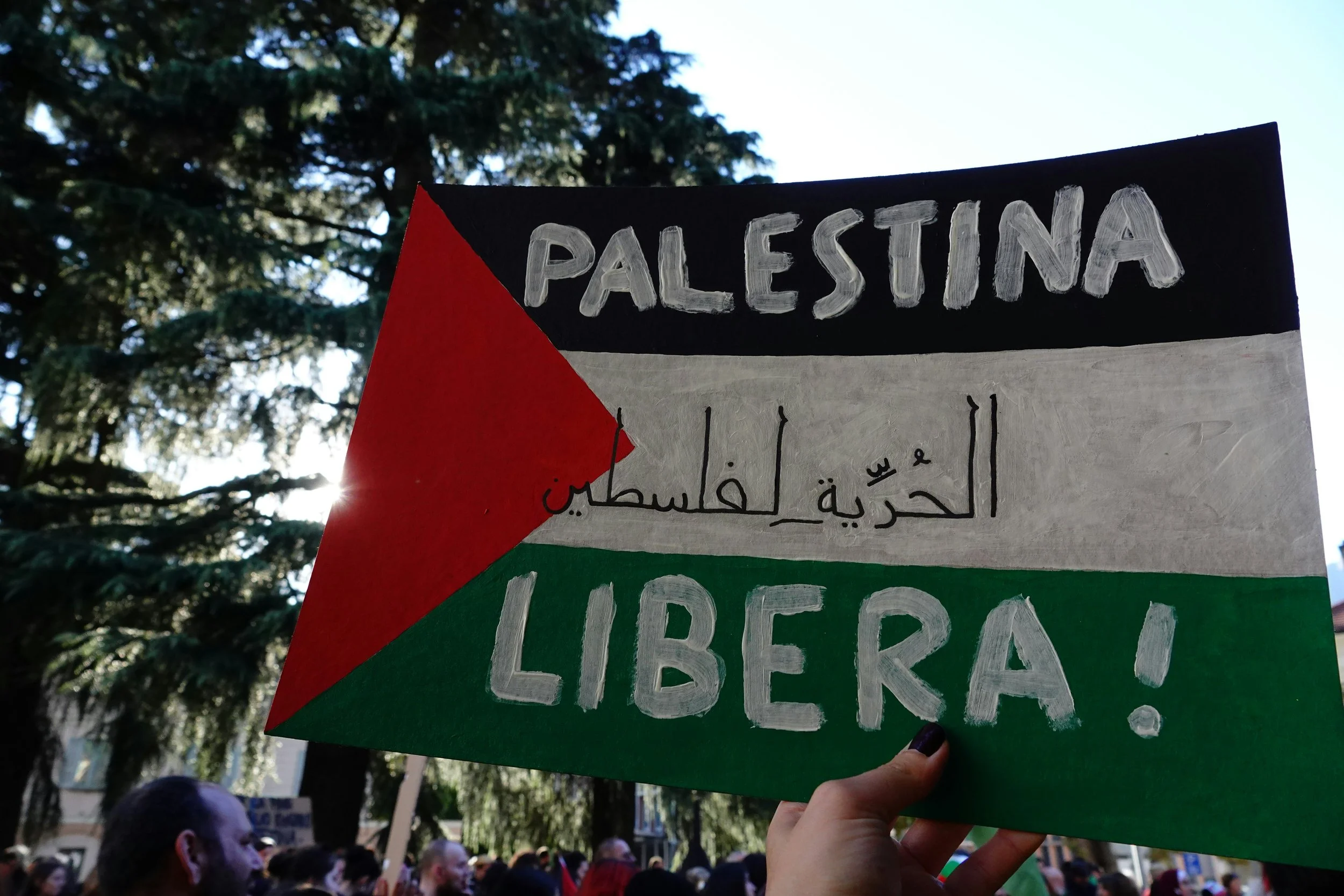
Fotografia di Delia Giandeini
A research report, on its own, changes nothing. Anyone who has produced documentation on violations of international law over the past few decades knows this well: Amnesty’s reports, Human Rights Watch’s investigations, and UN resolutions have, in the vast majority of cases, remained mere words on paper. The difference lies in what is built upon them.
The GPI’s work was not conceived as an academic contribution, but as a political tool: something to put into the hands of port workers, unions, university assemblies, and grassroots organizations seeking a concrete foundation for their actions.
The demands accompanying the dossier—a total bilateral arms embargo, the revocation of export permits, the suspension of fuel supplies, and the termination of the Italy-Israel military memorandum—are not rhetorical appeals to the government but a genuine grassroots political program against which to measure the gap between words and deeds. “For us, it is essential that this dossier help provide a common framework for all the demands of workers and those fighting against war and genocide,” explains Samed Ismail. “We know that the sectors most relevant to our research, such as logistics, are increasingly affected by anti-strike laws—a concrete demonstration that there is a plan to prevent and block union action. Our hope is to support these struggles precisely in the face of such restrictions.”
Learning to Call Things by Their Name
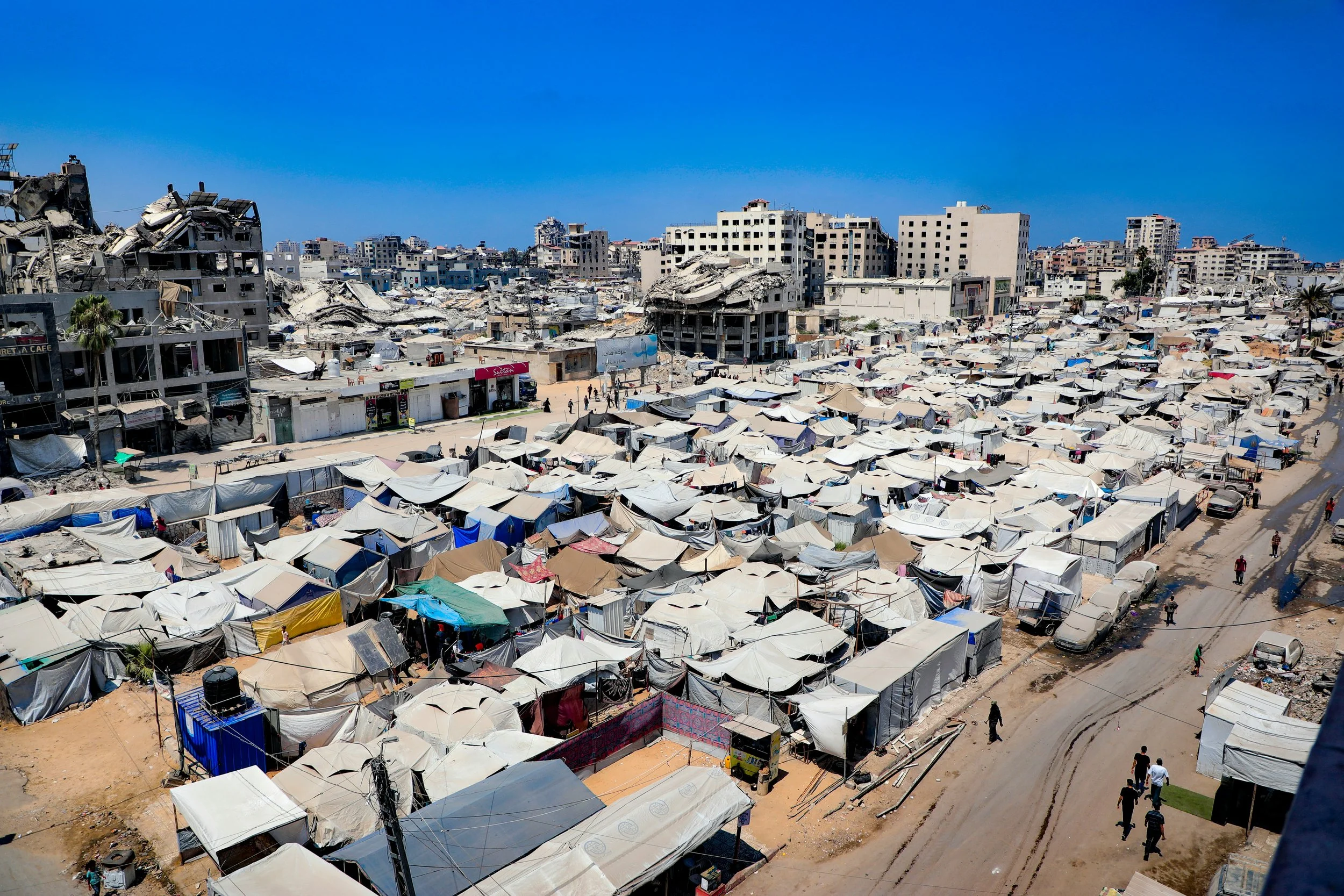
Fotografia di Mohammed Ibrahim
It is also important to remember that there is a battle of narratives underway, running parallel to the physical one. Western governments go to great lengths to avoid using the word “genocide,” while the mainstream media prefers terms like “conflict,” “war,” and “humanitarian crisis”—in other words, anything that shifts the focus away from those responsible and the political structure that supports them. Yet the group Lawyers and Jurists for Palestine has already filed a complaint with the International Criminal Court against the Italian government and Leonardo SpA for complicity in war crimes and crimes against humanity, explicitly naming Meloni, Tajani, Crosetto, and Leonardo’s CEO.
The GPI has chosen a different but complementary path: calling things by their proper names, documenting Italian complicity, and doing so with the precision needed to make that complicity unassailable on the basis of facts.
It is a political gesture that comes at a cost—in terms of repression, delegitimization, and isolation—and that is part of a tradition of internationalist solidarity that has deep, if often forgotten, roots in Italy. “The GPI aims—and has partly succeeded—to transform a paradigm that had taken hold at least since the Oslo Accords,” explains Ismail. “A paradigm in which we witnessed a gradual normalization of political and economic relations between Italy and Israel, and this process could only be hindered within a humanitarian framework, based solely on international law, and could not be directed against the entire Zionist project as an enemy to be dismantled. We are working to reverse this trend and reaffirm that the Palestinian liberation cause is a political cause, the cornerstone of the anti-imperialist struggle.”
“It is a necessary interpretive framework,” Ismail continues. “If we understand what it means, we cannot but acknowledge the fundamental role of the Resistance, the historic role of anti-Zionism, regional and beyond. Those of us who, like us, find ourselves in the diaspora can and must play a fundamental role in isolating and breaking the Zionist system, because we are even closer to the heart of its power. Organising the Arab and Palestinian diaspora means truly contributing to our cause of liberation — international, but with Palestine as its pivot. And it means participating in the strengthening of struggles against the system that sees in Zionism its bridgehead: capitalism, today on the threshold of a new phase of global war.”
For the full dossier: embargoforpalestine.com/italy
