
Carracci Casa Comune and Prosfygika
Geographies of possible housing.
by Camilla Donzelli
Two words keep coming up in public debate about housing: crisis and emergency. They are often used as if they described an unforeseen disruption, a temporary condition that can be resolved through targeted interventions. But what if we began to understand the housing crisis not as an anomaly but as a coherent outcome of our economic and social system?
This is the question at the heart of geographer Michele Lancione’s book For a Liberatory Politics of Home. As Lancione argues, a home is not simply a container for human life: it reflects the way a society chooses to inhabit the world. And the model we have built — grounded in private property, the treatment of housing as a market commodity, and the patriarchal nuclear family — not only fails to prevent housing precarity, but actively produces it.
There is no clear divide between those who are secure and those who are not. Instead, there is a continuum, a shared terrain of vulnerability that the system constantly generates and reproduces for everyone: from the growing difficulty of paying rent or a mortgage, to the exclusion of racialized and low-income communities, to gender-based violence that can turn the home into a dangerous place.
Recognizing the structural roots of the problem means understanding that housing cannot be treated as a technical issue to be addressed on a case-by-case basis. Building more units is not enough, nor are piecemeal public policies. What is needed is a radically different way of inhabiting the world — and, therefore, of living together.
Some people are already trying to build it. These are neither exceptional cases nor unattainable utopias. Carracci Casa Comune in Bologna and Prosfygika in Athens emerged from different histories and contexts.
Yet, both grapple with the same question: how can we create forms of housing that do not reproduce the exclusion, hierarchies, and violence embedded in the dominant model?
Carracci and the shared dream of a “good life”
A 24-unit apartment building stands at 63 Via Carracci, near Bologna’s railway tracks. Built in the early twentieth century, the building changed hands several times before the Emilia-Romagna Housing Agency (Acer), the public body responsible for managing social housing, acquired it in the early 2000s. In 2019, Acer terminated the tenants’ leases and emptied the building in preparation for selling it to private investors. From that moment on, it remained vacant and abandoned.
In October 2023, as part of the broader Radical Housing Project mobilization, the PLAT collective (Platform for Social Intervention) occupied the apartments on Via Carracci.
“Our collective has more than twenty years of experience in housing occupations, but Carracci marked a turning point,” said Luca, one of the residents. “At first, people in the neighborhood brought us clothes, assuming we were dealing with extreme poverty and marginalization. But many of the families living here are employed. Some have two incomes that together exceed €3,000 a month, yet they were forced out because their landlord wanted to rent the apartment for three times the price. That’s our new reality: too wealthy to qualify for social housing, too poor to afford market rents.”
According to data published by HousingAnywhere, Bologna ranked as Europe’s fifth most expensive city in early 2024, with studio apartment rents rising faster, percentage-wise, than in cities such as Paris and Berlin. The trend continued throughout 2025: according to a report by Immobiliare.it, sale prices increased by 5 percent while rents rose by a further 1.4 percent.
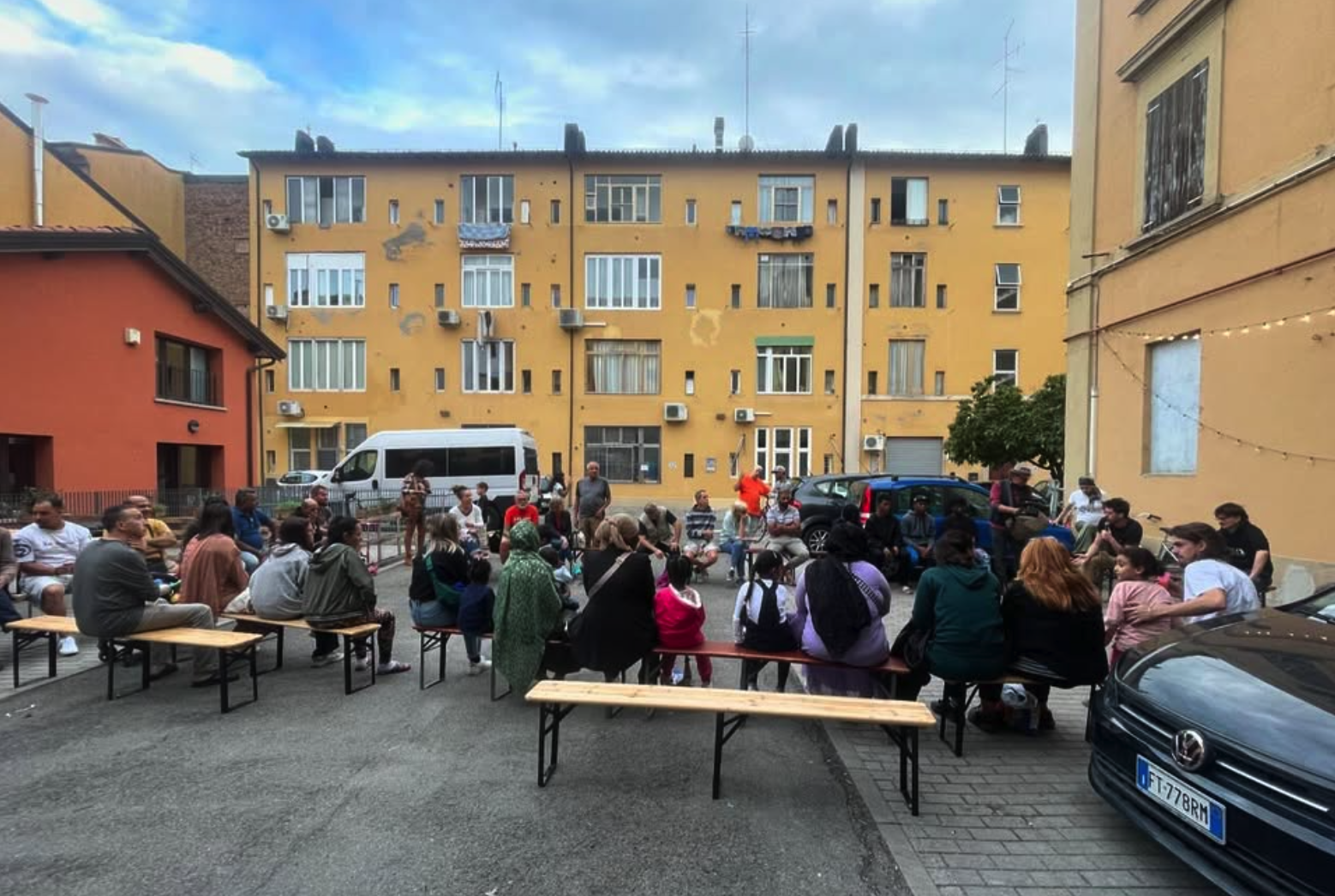
Carracci Casa Comune emerged as a response to this structural inaccessibility. The 110 people occupying the building adopted the slogan “We want a good life,” which, as Luca explained, is a political demand.
“We are not a movement for the right to a house, but for the right to inhabit. A house is just four walls and a roof. Inhabiting means much more than that: meaningful and fairly paid work, access to food, healthcare and public services, and access to education for our children.”
With this perspective in mind, Carracci has developed a multi-layered project that goes far beyond a simple occupation.
Over the past two years, after-school programs have been created not merely as services, but as spaces where parents collectively map the needs of the neighborhood. A shared courtyard and playground were built together with local residents and community associations. A multilingual help desk was established to support women navigating an often inaccessible welfare system, from enrolling children in daycare to dealing with bureaucratic procedures. “A room of our own,” a transfeminist workshop space for women and femininities from both Carracci and the surrounding neighborhood, was launched, alongside Fornelli Ribelli (“Rebel Stoves”), a project linked to a broader food mutual aid network.
Once the apartments reached full capacity and there was no longer space for new residents, Carracci developed new tools: the Mai Più Senza Casa (“Never Again Without a Home”) Committee and the Anti-Eviction Committee. In just six months, this network prevented more than 100 evictions. It is a practical expression of what Luca called the “right to inhabit”: not the individual management of an emergency, but the collective construction of grassroots power rooted in the territory.
Toward a metropolitan unionism
“For us, occupation is not the goal, but a means,” said Luca. “All the services and spaces we have created are tools of inquiry: a way to understand what is not working and how we can organize ourselves to demand change.”
What ties together the different initiatives developed by Carracci Casa Comune is the concept of metropolitan unionism. As Luca explained, it is an approach that seeks to move beyond the traditional model of trade unionism rooted in the factory or workplace, and instead engage with something more pervasive: the urban transformations driven by privatization and touristification, and the concrete impact these processes have on the lives of those who live and work in the city.
“In this sense, occupation is a tool of struggle,” Luca continued. “We do not use it simply to stay inside a building. We use it to open spaces for social negotiation, to build collective claims, and to redistribute wealth downward.”
It is a strategy that has produced tangible results. In the second half of 2024, eviction was avoided thanks to an agreement approved by the municipality, allowing Carracci residents to remain in their homes under temporary contracts renewed every six months. In Bologna, an agreement of this kind had not been reached in more than forty years.
The struggle, however, is far from over. At its center is the demand for the recognition of self-recovery: a mechanism through which residents invest their own resources to renovate abandoned housing units, restoring buildings that would otherwise be sold off to private investors or left to deteriorate. The costs of those improvements are then deducted from rent.
This approach stands in direct opposition to the dominant model that increasingly treats cities as sites of speculation and rent extraction. Rather than transferring neglected public assets into private hands, it seeks to restore collective value through the people who inhabit them.
The next step is Carracci Sogno Comune (“Carracci Common Dream”), a campaign through which the residents’ cooperative established over the past years is demanding formal stewardship of the building. The goal is for Carracci to be entrusted to the cooperative through a public call and permanently developed as a living laboratory for alternative forms of housing.
“If recognition of self-recovery were accompanied by the regional law currently under discussion, it would be a major step forward,” Luca concluded. “It would create a precedent — not only for Carracci, but, above all, in terms of making this model replicable elsewhere.”
Prosfygika and a new self-managed model of coexistence
Athens is one of the European cities where housing — and rental housing in particular — is becoming increasingly unaffordable. According to the latest available data, households in Greece spend between 36% and 40% of their disposable income on housing-related expenses, compared to an EU average of 19%. At the same time, Greece remains one of the EU countries with the lowest average wages, which have even declined by around 5% in recent years.
This trend is closely linked to the unchecked expansion of touristification: the more Greece becomes a desirable destination for international tourism, the more unaffordable everyday life becomes for local communities.
Within this context, a complex of eight apartment buildings along Alexandras Avenue, in central Athens, has for nearly a century offered a concrete response to mounting social and economic challenges.
In Greek, prosfygiká literally means “refugee housing.” The 228 apartments were built in the early 1930s to accommodate Greek refugees from Asia Minor who had fled the violence and mass expulsions that followed the Greco-Turkish War of 1919–1922. Two decades later, in December 1944, Prosfygika became a strategic stronghold for leftist militias during the Greek Civil War.
It is upon these layered histories of displacement and resistance that a new and radical experiment in communal living began to take shape in the early 2000s.
In 2010, in response to Greece’s ongoing economic crisis, a group of squatters initiated a process of internal reorganization. “We like to remember that moment through a particular image,” said Suzon, who has been part of the community for around five years. “Everyone placed the keys to their apartment on the table, symbolizing the recognition of the communal system that was about to emerge.”
Two years later, the Community of Squatted Prosfygika (SY.KA.PRO.) was formally established. Over time, the project would prove remarkably capable of adapting to increasingly complex social challenges.
In 2015, during the so-called refugee crisis that saw thousands of people cross the border between Turkey and Greece, Prosfygika became an important hub for asylum seekers and refugees. Those passing through Athens on their way to other European countries were not simply hosted there; they became active participants in community life, contributing their skills, energy, and perspectives.
“It was never a process where one group of people was building something for everyone else,” Suzon explained. “Every person who passed through, with their own needs and capacities, became part of that organic process.” This is why, she added, many people who have since left Prosfygika continue to maintain strong ties with the community: “They do not remember it as a place that accommodated them, but as something they belonged to.”
Today, the community is home to around 400 people from 27 different countries, bringing together a wide range of histories, languages, religions, and political backgrounds.
As Suzon pointed out, this coexistence is neither spontaneous nor magical: “It was a conscious decision from the beginning, something that had to be built over time. We chose to become a community.”
The key, Suzon explained, is not the erasure of differences, but the continuous effort to identify common ground from which shared perspectives can emerge. On this foundation, SY.KA.PRO. has developed a practice of coexistence that is also a political proposition: a model of society that can exist in the here and now, grounded in the collective self-management of difference and in mutual aid.
Politicizing everyday life
Inspired by revolutionary experiences ranging from Rojava to the Zapatistas, over the past sixteen years SY.KA.PRO. has developed twenty-two self-organized structures designed to meet the needs of both the community itself and the surrounding neighborhoods. These initiatives address everything from food and clothing to education, healthcare, maintenance, and cultural activities. The aim is to reclaim control over essential services, removing them from the hands of institutions and the market in order to adapt them to people's actual needs. Each structure operates through its own assembly, agenda, and budget, while remaining connected to the broader principles that guide community life as a whole.
At the heart of this system is the General Assembly, which meets every Monday to discuss matters affecting the community. Every Friday, a working group gathers to put those decisions into practice. Additional thematic groups are formed whenever needed — to organize an event, coordinate a project, or respond to an emerging issue. Every two years, the community also holds a review assembly to collectively assess the previous period and determine future priorities.
Yet the political dimension of Prosfygika extends far beyond formal assemblies. “Daily life is what builds community,” Suzon explained. “From the coffee we drink together to the interactions we have in the street, and everything we share in between — these are the fundamental elements.” It is through this politicization of everyday life that some of the community’s most significant structures have emerged: spaces that do not merely respond to immediate needs, but seek to transform the very way people live together.
The Bakery Structure emerged alongside the formation of the community itself, in response to a basic and urgent need: food. In the midst of the economic crisis, many people had no stable income and struggled to access essential goods.
With the support of a group of French internationalists, Prosfygika received several small domestic ovens and began producing bread collectively. But the goal was never simply to provide affordable food. From the beginning, the community was confronted with a question that opened up a broader political discussion: what happens when someone cannot even afford bread?
“We had long discussions about pricing,” said Ali, who is involved in the bakery. “The community decided that if someone needs bread but has no money, they should receive it for free.” The bakery thus became more than a mutual aid project: it became a space where everyday needs are politicized. The issue is not merely the distribution of bread, but a collective reflection on what access, care, and redistribution mean in a context shaped by precarity.
For Elo, an internationalist involved in the structure, the bakery is also a laboratory of coexistence. Working together becomes a daily exercise in communication, conflict resolution, and mutual learning within a community where many different languages are spoken. The bread itself reflects the multicultural composition of Prosfygika: alongside more familiar recipes, Syrian pastries and foods from other cultural traditions transform baking into a space of exchange.
The bakery is also open to the public, serving as a point of connection with the wider city. Daily conversations and relationships built with everyone who walks through its doors are an important part of the community’s rootedness. “We try to speak with everyone who comes in,” Elo added, “to understand who they are, what they do, what their needs are, and how we can support one another.”
Another structure that has come to play a central role over the years is the Women Structure, formally established in 2019 in response to the need for a dedicated space where women and feminine-presenting people could come together. “Many were isolated and largely absent from collective spaces,” Suzon explained. It began with informal gatherings over coffee, visits from house to house, and the slow work of building trust. Over time, the space also became a place where shared experiences could be voiced and issues often confined to the private sphere — including domestic violence — could be made visible.
Out of these experiences, the structure developed collective practices of support and intervention, ranging from mediation and transformative justice processes to the creation of a safe house for emergency situations, open to people both inside and outside the community. During the 2021 review assembly, the work of the Women Structure was collectively recognized as an “internal revolution.” The significance of that recognition is clear: if the goal is to build an alternative to the dominant model of housing, it also requires dismantling the power relations that shape life within the home itself.
Reclaiming the meaning of housing
Today, Prosfygika is under threat. For at least three decades, eviction attempts have followed one another regardless of the political orientation of successive governments. In 2025, however, eviction became a concrete possibility. A €15 million regional “regeneration and development” plan is currently being implemented, one that would displace the community’s residents, including many people facing social and economic vulnerabilities.
The community has been mobilizing for months. Two of its members have been carrying out a hunger strike until death to protest the eviction. After a long period of silence, the Greek government finally responded through government spokesperson Pavlos Marinakis, who confirmed the intention to proceed with the eviction.
The pattern is a familiar one: whenever a space succeeds in generating social bonds, mutual aid, and grassroots forms of organization, institutions and markets tend to view it as a dangerous deviation, an anomaly that exists outside the logic of profit and must therefore be neutralized.
Yet the story of Prosfygika speaks to something far larger than Athens. Across Europe, as housing becomes increasingly inaccessible, the dominant response continues to follow the same trajectory: the privatization of public assets, touristification, policies that favor real estate speculation, and temporary measures incapable of addressing the structural roots of the crisis. It is a revealing signal: a genuine solution to the housing crisis cannot emerge from the same economic, political, and social system that helps produce it.
This is precisely why experiences such as Prosfygika and Carracci Casa Comune matter. Although shaped by different histories and contexts — and without claiming to offer perfect or easily replicable models — they open up spaces of possibility. They remind us that housing can mean something more than mere survival within a hostile market. It can become a collective, conflictual, and radical practice of reclaiming everyday life.
