
Arms Race: when War enters the factories
From metalworking plants to ammunition factories: the hidden consequences of Europe’s rearmament
by Caterina Orsenigo
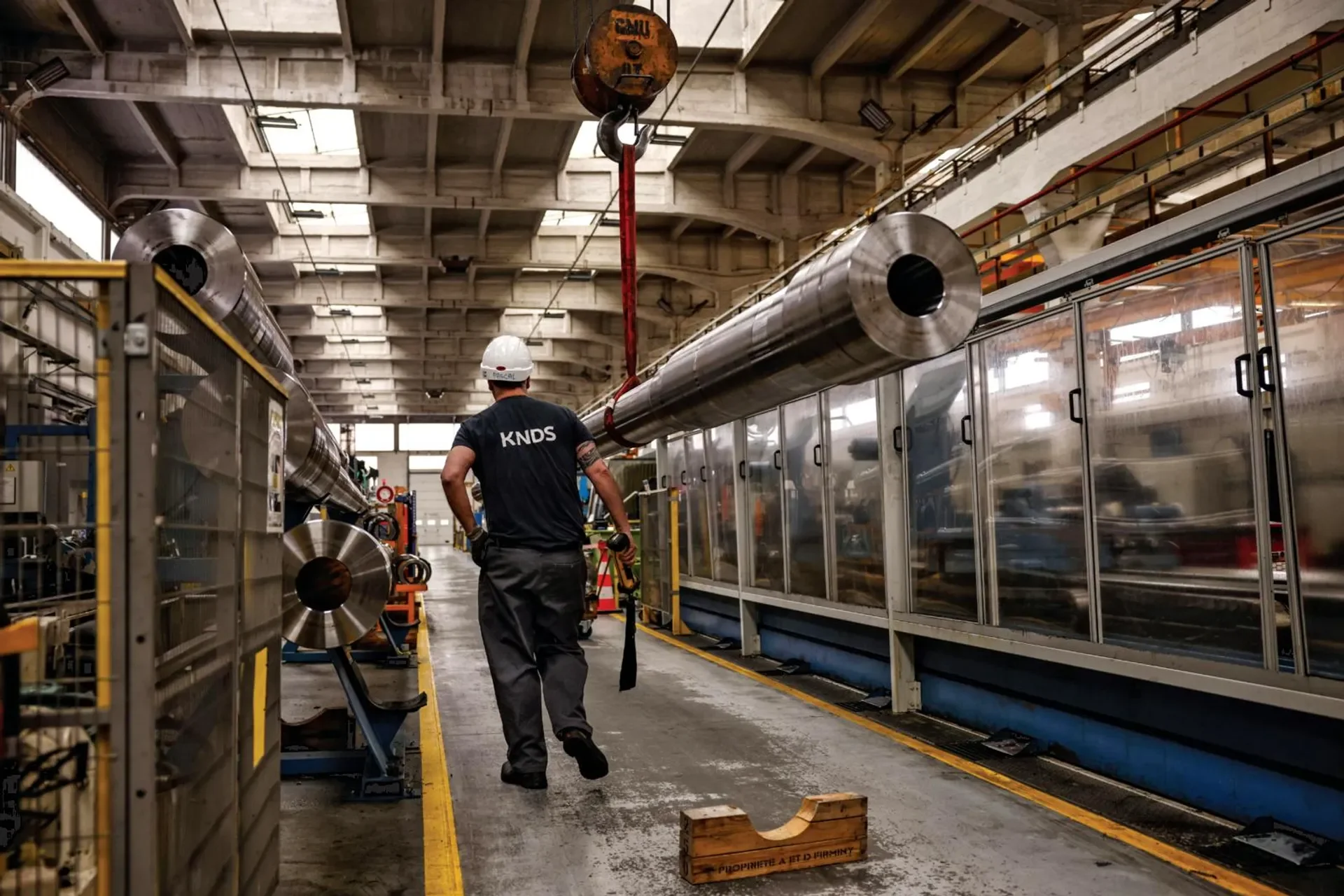
Every day, a worker in a metalworking factory listens to the radio, and the radio talks about war: Lebanon, Iran, Gaza, maybe sometimes Sudan too. A colleague shows him videos full of soldiers, weapons, wounded people, and corpses. He feels how terrible all of this is, but also how distant it is from his everyday life of home and factory. Of course it affects him, perhaps deeply, but only in the form of high utility bills and inflation — violent in their own way, yet without the shape and smell of weapons and blood. Then one piece of news strikes him. It says that arms production in Italy has increased. Suddenly, war takes on a concrete and nearby form.
The Invisible Supply Chain of Italy’s Arms Race
The worker shapes bronze washers without knowing what they are for. A few searches are enough for him to put the pieces together and finally see the whole picture. “Everyone works on one part. That’s how distance is maintained. (…) While I work at the lathe producing a mechanical component, even the smallest one, (…) I belong to the supply chain and feed the production flow. I contribute to the construction of vehicles like the Centauro II, vehicles that are part of the wars I used to hear about on the radio. In some way, we contribute to those news stories too. Ordinary people who wake up in the morning and go to work, convinced they are doing nothing wrong.”
It recalls a scene from The Working Class Goes to Heaven, where the old worker Militina tells Lulù: “A man has the right to know what he is doing, what it is for.”
The article was written by Simone Babore, a metalworker, and published in 2026. It is an invaluable contribution because we desperately need to keep that whole picture in front of our eyes. War enters our lives because it is made with our taxes, resources, electricity, and labor.
The tank we happen to see in a war photograph on social media may contain bolts manufactured just a few kilometers from where we live.
The numbers behind the arms race and the expansion of the military industry
The news mentioned by Babore comes from Stockholm International Peace Research Institute, an independent research institute that studies conflicts, armaments, disarmament, and military spending worldwide. In a report titled Global arms flows rise by almost 10% as European demand surges, we read that “Italy’s arms exports increased by 157%, moving the country from tenth place among the world’s largest exporters in 2016–2020 to sixth place in 2021–2025. More than half of Italian exports went to the Middle East (59%), while 16% went to Asia and Oceania and 13% to Europe.”
A 2025 report by the European Council also states that defense investments increased by 62% between 2020 and 2025.
These are numbers, but numbers happen somewhere. They happen in the metalworking factory where Babore works, and they happen in projects for explosive and ammunition factories, where pretending not to know becomes impossible and where the consequences directly affect local territories.
In recent months, in Anagni, in the province of Frosinone, KNDShas been negotiating with the regional authorities to transform an old industrial plant into an explosives and ammunition factory.
The Anagni case and the arms race in industrial territories
Anagni lies in the Sacco Valley, an area south of Rome industrialized during the twentieth century through chemical production and the arms industry. Nearby Colleferro was founded in 1912 around the site of Bombrini Parodi-Delfino, later known as BPD Difesa e Spazio, a gunpowder and explosives factory. Since then, BPD expanded, changed ownership, broadened its expertise, and is now controlled by KNDS.
In Anagni, meanwhile, the core business since the 1970s has been the chemical industry, from which an important pharmaceutical hub later developed. Weapons and chemicals are closely linked, and both have contributed over decades to polluting the area. Heavy metals remain in the soil, and illegal discharges from the pharmaceutical district still flow into the Sacco River today.
In 2005, following the death of 25 cows from cyanide poisoning, β-hexachlorocyclohexane (β-HCH), a carcinogenic molecule derived from the processing of the pesticide Lindane, was identified in raw milk samples. It became clear how deeply the entire territory had been contaminated: the legacy of a century of explosives, rocket and missile propellants, chemical substances, launch engines, and railway carriage production had spread throughout the valley through the river and its periodic floods.
The area was declared a National Site of Interest for remediation. Six thousand livestock animals were slaughtered, and farming and livestock breeding intended for human consumption were banned. It was a disaster for the valley’s inhabitants. Ten years passed between consultancy studies and largely ineffective task forces, and finally, in 2019, 53 million euros were allocated to secure the territory. To this day, only 0.2% of the area has been remediated, though some hope remained that the valley’s destiny could change.
Then came the funds from the 2023 ASAP plan (Act in Support of Ammunition Production), a program preceding ReArm Europe and aimed at increasing ammunition and missile production across Europe. And so we arrive at the KNDS project, which is proceeding almost unnoticed — above all under the silence of local administrations and local media.
A reverse transition, from ecological to military, impossible not to see for those who live in the area, yet invisible to everyone else.
During the April 21 Conference of Services, in which KNDS representatives were expected for the second time to present environmental impact assessment documents to the regional authorities, local institutions were entirely absent. Only local collectives, particularly Disarmiamoli and the No War Assembly of the Sacco Valley, made themselves heard by protesting, attending the conferences, studying the documents, spreading information, and searching for alternative solutions for an ecological reindustrialization of the valley.
According to the Disarmiamoli collective, even Daniele Natalia, the center-right mayor of Anagni, failed to attend. It would be his duty to take responsibility for issuing a health-related opinion, yet legally his silence will be interpreted as approval.
Just as the metalworking factory silently accepts a contract from Leonardo, so too the mayor of a community already scarred by cancer appears willing to accept the proposal in exchange for a handful of documents and only 25 jobs.
“As Mayor, I cannot ‘ban’ an activity permitted by law. What I can and must do is ensure that every step takes place with all the environmental and safety guarantees required, with clear prescriptions and strict controls. It would be different if this involved establishing a completely new activity on undeveloped land requiring zoning changes and discretionary administrative choices — in that case there would be a clear political will either to support or reject a new settlement. Here, instead, we are dealing with the industrial continuity of a historically established activity. And within this framework, the Municipality will enforce every protection possible within the procedures, exclusively in the interest of the territory,” Daniele Natalia told Voice Over.
What he does not explain, however, is why he did not consider it important to personally attend the Conference of Services where the interests and protection of the territory were being evaluated.
But the numbers of global rearmament take shape in other ways too.
The Arms race between ecological crisis and the diversion of resources
A recent paper by researchers Anabel Marin and Phil Johnstone from the University of Sussex raises a crucial issue. We are aware — though less than we should be — that the energy and digital transition comes at a high cost in terms of mineral extraction and refining: energy-intensive and polluting processes with enormous impacts on land, water, and local populations.
But arms production also requires vast quantities of lithium, tungsten, rare earths, cobalt, and silicon. And not only does it require them — it requires them urgently. This negatively affects both the scale of extraction and compliance with already weak sustainability standards. Even the classification of “critical” materials is influenced by this dynamic; among the highest-ranked elements on official lists is samarium, whose use is almost entirely linked to defense.
Everything is shaped by war — a war defined by the authors as “highly mineral-intensive.” Marin and Johnstone note that global military spending has reached 2.72 trillion dollars, “almost five times the current public investment in low-carbon technologies.”
The military transition is stealing space, attention, effort, funding, and resources from the ecological transition: it diverts minerals necessary for renewables and electrification, or worse, massively increases already problematic extraction; it erases promises of environmental remediation and replaces them with explosives factories. In doing so, it transforms the face of the European Union.
The SIPRI study also confirms that these weapons are not being produced and stockpiled in preparation for some hypothetical Russian attack, but rather to be sold to the Middle East.
And the most important thing is that there is nothing democratic about any of this.
Decisions on military spending and rearmament programs are made primarily by the Council of the European Union — that is, the governments of member states — and by the European Commission, through instruments such as the European Defence Fund and joint industrial programs. These choices are then translated into national investments and authorizations without direct voting by European citizens on individual programs. In this sense, the direction of the arms race develops through representative institutional levels, but without direct democratic participation in specific operational decisions.
Only 23% of Europeans believe the EU should invest primarily in defense; most prefer healthcare and educational infrastructure and climate action. In Italy, the figure falls to 12%.
We dismiss the success of China’s energy transition as the product of an authoritarian system, yet we accept a 68% increase in military spending over five years without any public approval; we accept explosives factories being built on our territory despite local protests and opposition; and we accept that a worker may not even have the right to choose whether or not to manufacture components destined for war.
As Militina says, a man has the right to know what he is doing, what it is for.
